Reviewed: 28 September 2026. “Motivation letter,” “personal statement,” “statement of purpose” and “scholarship essay” are often used as if they mean the same thing. They do not always mean the same thing, and treating them as interchangeable can weaken an otherwise strong application.
The safest rule is simple: follow the exact prompt and document name used by the scholarship or university. If the provider asks for a motivation letter, answer like a motivation letter. If it asks for a personal statement, do not automatically submit the same document with a different heading.
This guide explains the differences, when each document is used, and how African students can adapt one evidence bank into several application formats without copying the same essay everywhere.
For a complete application-preparation system, use AfricanBase’s Scholarship Application Documents Checklist.
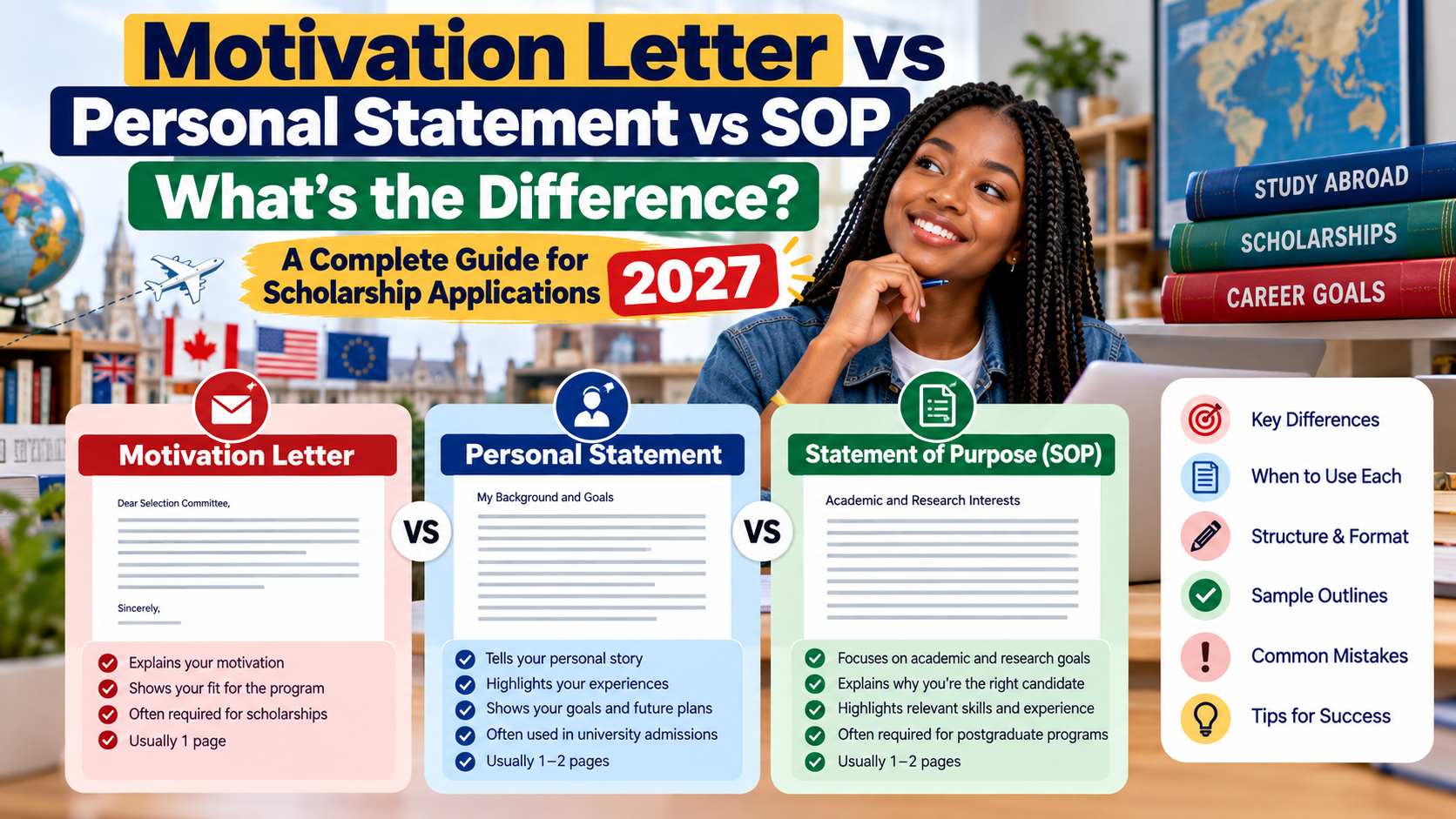
Quick Comparison: Motivation Letter vs Personal Statement vs SOP
| Document | Main focus | Typical question | Common use |
|---|---|---|---|
| Motivation Letter | Why you want the opportunity and why you fit it | Why this programme/scholarship? | Scholarships, universities, exchange programmes |
| Personal Statement | Your background, experiences, values and development | Who are you and what shaped your goals? | Admissions, scholarships, fellowships |
| Statement of Purpose (SOP) | Academic and professional direction | What do you want to study and why? | Graduate admissions, research programmes |
| Scholarship Essay | Response to a specific selection prompt | Leadership? Impact? Goals? Challenge? | Scholarship competitions |
| Cover Letter | Why you fit a specific role or opportunity | Why should we consider you? | Internships, fellowships, jobs, some programmes |
What Is a Motivation Letter?
A motivation letter explains why you want a particular programme, scholarship or opportunity and why your background makes that choice logical.
It usually answers questions such as:
- Why this programme?
- Why this institution?
- Why this scholarship?
- What are your academic or professional goals?
- How will the opportunity help you achieve them?
A strong motivation letter connects three things:
- what you have already done;
- what you need next;
- why this specific opportunity is the right bridge between the two.
Motivation Letter Example Structure
Opening: I am applying for [programme/scholarship] because my experience in [field] has shown me the need to develop [specific skill or knowledge].
Background: Through [study, work, project or volunteering], I developed experience in [specific area].
Programme fit: The programme’s [module, faculty, research area or practical component] directly supports my goal of [specific goal].
Future plan: After the programme, I intend to [specific next step] and apply the training to [problem, community, sector or profession].
What Is a Personal Statement?
A personal statement usually gives the reader a broader picture of who you are, what shaped your interests and why your experiences matter.
It can include:
- academic development;
- personal experiences;
- leadership or community involvement;
- challenges and growth;
- career direction;
- values relevant to the opportunity.
A personal statement is not an autobiography. You do not need to tell your entire life story. Select experiences that explain why you are prepared for the opportunity you are seeking.
Personal Statement Example Structure
Experience: During [specific experience], I became interested in [field/problem].
Development: That interest led me to [study, project, work or volunteering], where I learned [specific skill or insight].
Growth: A later challenge or responsibility taught me [lesson].
Direction: These experiences now shape my goal of [academic/professional objective].
What Is a Statement of Purpose (SOP)?
A Statement of Purpose is usually more academic and professionally focused than a personal statement. It explains what you want to study, why you are prepared for it and what you plan to do with the training.
Graduate programmes commonly expect an SOP to discuss:
- academic background;
- research interests;
- relevant work or project experience;
- specific programme fit;
- faculty or research alignment where appropriate;
- short- and long-term goals.
SOP Example Structure
Academic foundation: My undergraduate training in [field] introduced me to [specific topic].
Research/professional experience: Through [project/work], I developed experience in [specific method, problem or skill].
Current gap: To progress toward [goal], I need deeper training in [area].
Programme fit: [Programme Name] offers [specific module, research group, lab or faculty strength] that directly addresses this need.
Future direction: I intend to use this training to [specific research, professional or policy goal].
What Is a Scholarship Essay?
A scholarship essay is usually a direct response to a specific prompt. It may ask about:
- leadership;
- community impact;
- career goals;
- financial need;
- a challenge you overcame;
- why you deserve the scholarship;
- how you will contribute after graduation.
The biggest mistake is answering a scholarship prompt with a generic personal statement.
If the question asks about leadership, give leadership evidence. If it asks about community impact, show what changed because of your action.
For the full writing process, use AfricanBase’s Scholarship Essay Guide and Scholarship Essay Examples for African Students.
What Is a Cover Letter?
A cover letter is usually more direct and opportunity-specific. It explains why your experience matches a role, internship, fellowship or programme.
Unlike a personal statement, it normally focuses less on your life story and more on:
- the opportunity you are applying for;
- your most relevant qualifications;
- evidence of fit;
- what you can contribute;
- why you are interested in that organisation.
Can You Reuse the Same Document?
You can reuse facts and evidence, but not blindly reuse the same final text.
For example, one leadership experience might appear in:
- a personal statement as part of your development;
- a scholarship essay as evidence of leadership;
- a motivation letter as proof of your commitment;
- a cover letter as evidence of relevant experience.
The facts remain the same, but the emphasis changes.
Build an Evidence Bank Instead of One Universal Essay
Create a private document containing:
- leadership examples;
- community impact examples;
- academic achievements;
- research projects;
- work experience;
- challenges and lessons;
- career goals;
- reasons for choosing specific fields;
- measurable results;
- awards and recognition.
Then select the evidence that answers each application prompt.
How to Know What the Application Really Wants
Look at the verbs in the prompt.
| Prompt verb | What the reviewer expects |
|---|---|
| Describe | Explain what happened clearly |
| Explain | Show why something happened or matters |
| Demonstrate | Provide evidence |
| Reflect | Show what you learned |
| Justify | Give reasons for a choice |
| Discuss | Develop the issue with evidence and interpretation |
The document title matters, but the prompt matters even more.
Motivation Letter vs SOP: Key Difference
A motivation letter usually emphasizes why you want the opportunity. An SOP usually emphasizes your academic preparation, programme fit and future study/research direction.
There can be overlap. If a university uses the term “motivation letter” but asks detailed academic and research questions, follow the questions rather than forcing a generic definition.
Personal Statement vs Scholarship Essay
A personal statement is often broader and narrative. A scholarship essay is normally narrower because it responds to a specific selection question.
For example:
Personal statement prompt: “Tell us about yourself and your academic goals.”
Scholarship essay prompt: “Describe a time you demonstrated leadership and explain what you learned.”
The second requires a specific evidence-based story rather than a broad life narrative.
What Should African Students Avoid?
- Using one generic document for every programme.
- Changing only the university name.
- Copying sample letters word for word.
- Writing exaggerated hardship stories.
- Using vague phrases such as “I have always been passionate.”
- Ignoring the prompt because you already have a prepared essay.
- Inventing leadership or community impact.
- Using AI-generated text without checking accuracy and provider rules.
How Long Should Each Document Be?
There is no universal length. Follow the application’s stated limit.
If no limit is given, keep the document focused and avoid adding content simply to make it longer. A concise, specific document is usually stronger than a repetitive one.
Do You Need a Different Document for Every Scholarship?
Usually, yes at the final-draft level. You can reuse verified facts and evidence, but the final document should respond to that programme’s criteria and wording.
For reusable planning frameworks, see AfricanBase’s Scholarship Application Templates.
How These Documents Fit Into a Full Scholarship Application
A typical application may combine several different documents:
- CV for your factual record;
- personal statement for background and development;
- SOP for academic or research direction;
- scholarship essay for a specific selection criterion;
- motivation letter for programme fit;
- reference letters for third-party evidence.
Your referees should support your application rather than repeat your essay. Use AfricanBase’s Scholarship Reference Guide to prepare them properly.
Frequently Asked Questions
Is a motivation letter the same as a personal statement?
Not always. A motivation letter usually focuses on why you want a specific opportunity and why you fit it, while a personal statement often gives broader context about your background and development.
Is an SOP the same as a motivation letter?
They can overlap, but an SOP is usually more academic and focused on study, research and career direction.
Can I use my SOP as a scholarship essay?
Only if it directly answers the scholarship prompt. Otherwise, rewrite it around the actual selection question.
Can I submit the same personal statement to several universities?
You can reuse your core evidence, but the final version should be adapted to each programme’s requirements and fit.
Which document is most important?
The document the application actually asks for. A perfect SOP does not help if the scholarship asks for a 300-word leadership essay and you fail to answer it.
Final Advice
Do not begin by asking, “Which template should I use?” Begin by asking, “What is this application trying to learn about me?”
Once you understand the purpose, choose the right evidence, follow the requested format and write specifically for that opportunity.
Continue with AfricanBase’s Scholarship Application Documents Checklist, Scholarship Essay Guide and Reference Guide.