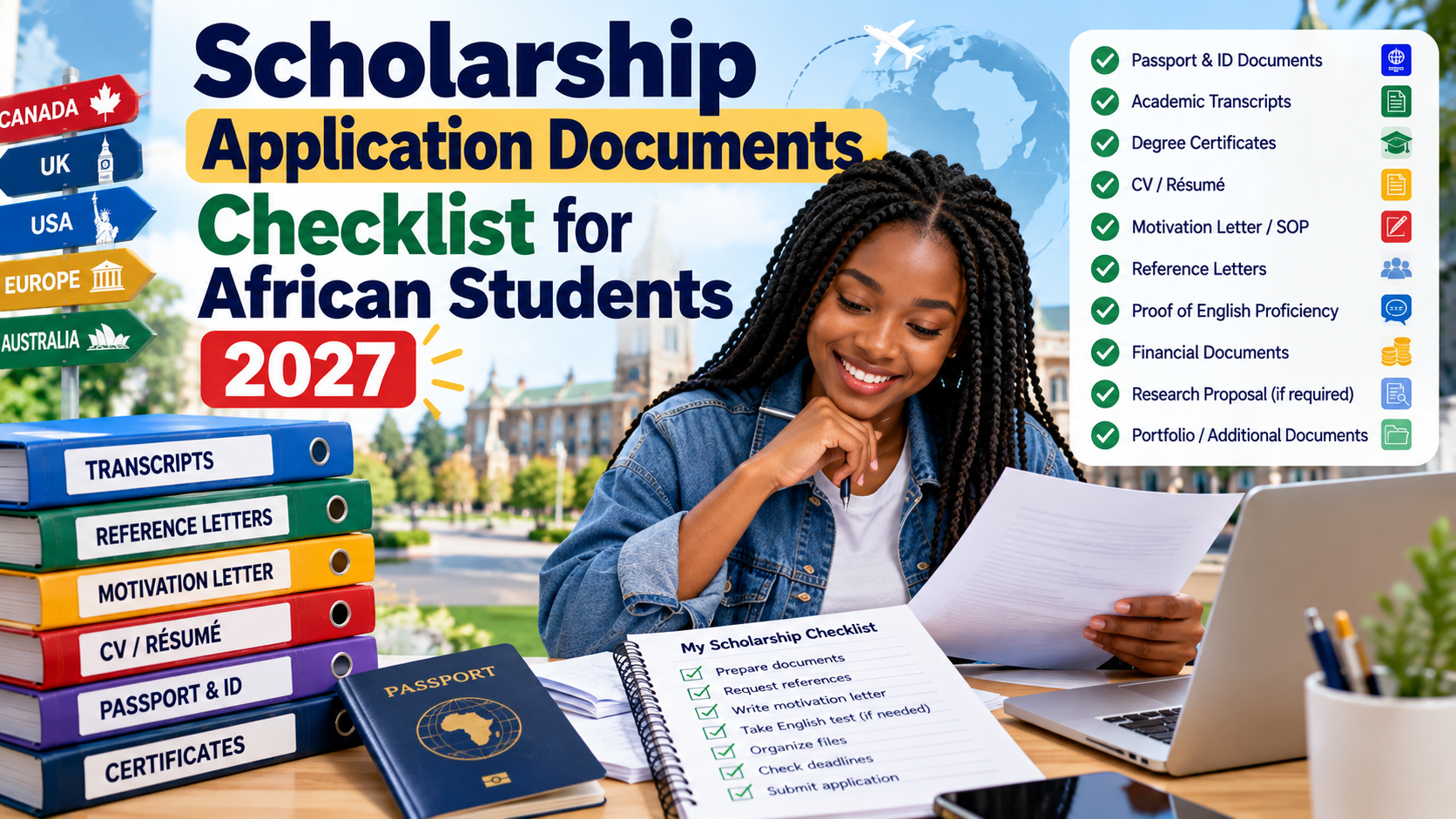
Reviewed: 28 September 2026. Scholarship applications often fail because of missing, outdated or inconsistent documents rather than because the applicant lacks potential. The safest approach is to build a reusable document pack before major 2027 scholarship windows open, then adapt it to each programme’s official checklist.
This guide is designed for African students applying for undergraduate, master’s and PhD scholarships abroad. It explains which documents are commonly required, which ones are programme-specific, how to organise them, and what to verify before submission.
Use this together with AfricanBase’s Scholarship Application Calendar and scholarship shortlist framework.
Quick Scholarship Documents Checklist
| Document | Commonly required? | What to check |
|---|---|---|
| International passport | Very common | Name, date of birth, expiry date, readable bio page |
| Academic transcript | Very common | Official version, grading scale, complete semesters/years |
| Degree or school certificate | Very common | Correct award title and graduation date |
| CV / résumé | Common | Current education, work, leadership, awards and dates |
| Personal statement / motivation letter | Common | Programme-specific, within word limit |
| Reference letters | Common | Correct referee type, submission method and deadline |
| English-language evidence | Depends | IELTS/TOEFL/PTE or accepted alternative |
| Financial documents | Depends | Needed mainly for need-based awards or visa/admission stages |
| Research proposal | Often for research degrees | Length, format, supervisor/programme requirements |
| Portfolio | Programme-specific | Required for design, arts, architecture and some technical fields |
| Nomination / endorsement | Programme-specific | School, employer, government or university nomination route |
| Certified translations | When needed | Follow the provider’s translation rules exactly |
1. International Passport
Your passport is one of the first identity documents many scholarship and university portals ask for. Before uploading it, check that:
- your full name matches your academic records;
- your date of birth is correct;
- the bio page is clear and uncropped;
- the passport will remain valid through the application and travel timeline;
- the file is saved in the format and size the portal accepts.
If your name appears differently across your passport, transcript and certificates, do not ignore the mismatch. Use the provider’s instructions for explaining or documenting name changes.
2. Academic Transcript
A transcript usually shows your courses, grades and academic progression. Depending on the programme, you may need:
- secondary-school transcript;
- WAEC/NECO or equivalent results;
- university transcript;
- current transcript if you have not yet graduated;
- official grading scale or explanation of the institution’s grading system.
Do not convert your grades into a foreign GPA unless the university or scholarship explicitly instructs you to do so.
3. Degree Certificate or School-Leaving Certificate
Graduate scholarships often require your degree certificate, while undergraduate awards may ask for secondary-school completion documents.
If you have not yet graduated, the provider may accept:
- statement of result;
- provisional certificate;
- official letter confirming expected graduation;
- current transcript.
Only use an alternative document if the scholarship or university confirms it is acceptable.
4. CV or Résumé
A scholarship CV should be factual and easy to scan. Typical sections include:
- education;
- work experience;
- research;
- leadership;
- volunteering;
- awards;
- publications or projects;
- professional training;
- relevant skills.
Use exact dates and avoid inflating responsibilities. If you led a project, explain what you actually did rather than using vague titles.
5. Personal Statement, Motivation Letter or Scholarship Essay
These documents are not interchangeable in every application. A motivation letter may focus on why you want the programme; a scholarship essay may ask about leadership, impact or goals; a personal statement may combine academic and personal context.
Before writing, identify:
- the exact prompt;
- word or character limit;
- selection criteria;
- whether examples must come from work, school or community experience;
- whether AI use is restricted.
Use AfricanBase’s scholarship essay guide and essay examples guide to structure your answers.
6. Recommendation or Reference Letters
Many scholarships require one, two or three referees. The most important point is not just the number—it is the type of referee required.
A programme may ask for:
- academic referee;
- professional supervisor;
- research supervisor;
- community or leadership referee.
Check whether the referee uploads the letter directly or whether you upload it yourself. These are different processes.
AfricanBase’s reference-request guide explains how to approach referees and prepare a referee pack.
7. English-Language Evidence
Depending on the programme, accepted evidence may include:
- IELTS;
- TOEFL;
- PTE;
- Duolingo English Test;
- medium-of-instruction letter;
- previous degree taught in English;
- programme-specific waiver.
Do not assume that because a scholarship does not require IELTS, the university also waives its English requirement. Scholarship and admission rules can be separate.
8. Financial Documents
Not every scholarship asks for financial evidence at the scholarship stage. Need-based programmes are more likely to request it.
Possible documents include:
- household income statement;
- bank records;
- tax documents;
- employment letters;
- proof of dependants;
- sponsor statement;
- financial-aid forms.
Do not upload unnecessary sensitive financial information unless the official application requests it.
9. Research Proposal
PhD and research-focused master’s scholarships may require a proposal. Typical sections can include:
- research problem;
- background;
- research questions;
- methodology;
- expected contribution;
- timeline;
- references.
Proposal length and structure vary significantly. Use the university’s own guidance rather than a generic online template.
10. Portfolio, Writing Sample or Technical Work
Some programmes require evidence beyond grades and essays. This can include:
- design portfolio;
- architecture portfolio;
- creative writing sample;
- coding portfolio;
- published research;
- project report;
- audition or performance material.
Follow file-size and formatting instructions carefully. Large portfolios may use a separate upload system.
11. Nomination or Endorsement Documents
Some scholarships cannot be accessed by direct self-application.
Examples of nomination routes include:
- school nomination;
- university nomination;
- employer nomination;
- government ministry nomination;
- embassy nomination.
This matters because a scholarship deadline may not be the first deadline. Your school or nominating body may have an earlier internal deadline.
For example, the Lester B. Pearson International Scholarship requires school nomination before the student completes the scholarship application.
12. Certified Translations
If your document is not in the language accepted by the institution, you may need a certified translation.
Check whether the provider requires:
- a certified translator;
- translator declaration;
- notarisation;
- original-language copy plus translation;
- specific certification wording.
Do not translate official documents yourself unless the provider explicitly permits it.
Documents by Study Level
Undergraduate Applicants
- passport;
- secondary-school certificate/results;
- school transcript;
- school nomination where required;
- personal statement;
- references;
- English-language evidence;
- leadership/community evidence.
For current opportunities, see AfricanBase’s Fully Funded Undergraduate Scholarships for Nigerian Students 2027.
Master’s Applicants
- passport;
- degree certificate;
- university transcript;
- CV;
- motivation letter or essays;
- academic/professional references;
- English-language evidence;
- work-experience proof where required.
PhD Applicants
- passport;
- bachelor’s and master’s certificates;
- transcripts;
- academic CV;
- research proposal;
- references;
- publications or writing sample where required;
- supervisor correspondence where relevant;
- English-language evidence.
Create a Scholarship Document Folder Before You Apply
Use a folder structure that makes documents easy to update:
Scholarships 2027/
├── 01 Passport/
├── 02 Transcripts/
├── 03 Certificates/
├── 04 CV/
├── 05 References/
├── 06 Essays/
├── 07 English Test/
├── 08 Financial Documents/
├── 09 Research Proposal/
└── 10 Submitted Applications/
Inside each scholarship folder, keep the final submitted versions separate from drafts.
Use Clear File Names
Avoid filenames such as scan001.pdf or finalfinal2.pdf.
Better examples:
Emmanuel_Samuel_Passport.pdfEmmanuel_Samuel_Transcript_BSc.pdfEmmanuel_Samuel_CV_2027.pdfEmmanuel_Samuel_Reference_Dr_Name.pdf
If a portal specifies a naming convention, follow that convention instead.
Check Document Consistency
Before submission, compare:
- full name;
- date of birth;
- institution names;
- graduation dates;
- employment dates;
- programme name;
- scholarship name;
- referee details.
Small inconsistencies can create unnecessary questions during review.
Do Not Upload Documents Too Early
Build your document pack early, but obtain expensive or time-sensitive documents only when needed.
Examples include:
- certified translations;
- medical reports;
- police certificates;
- fresh bank statements;
- official courier transcripts.
These may expire or become outdated before the actual application stage.
Seven-Day Scholarship Document Preparation Plan
| Day | Task |
|---|---|
| Day 1 | List all scholarships and download official checklists |
| Day 2 | Scan passport, certificates and existing transcripts |
| Day 3 | Update CV and leadership/activity evidence |
| Day 4 | Contact referees and prepare referee packs |
| Day 5 | Prepare essay evidence bank and programme notes |
| Day 6 | Identify translations, tests or missing official documents |
| Day 7 | Verify names, dates, file formats and deadlines |
Final Pre-Submission Checklist
- Am I using the current scholarship cycle?
- Do I meet every mandatory eligibility requirement?
- Are all names and dates consistent?
- Are scans readable?
- Are translations certified correctly?
- Are essays within the word limit?
- Have referees received the correct deadline?
- Does the portal show every required upload as complete?
- Have I saved a copy of the final submission?
- Have I recorded the application reference number?
Frequently Asked Questions
Do I need every document before I start applying?
No. Requirements differ. Build the reusable documents first, then follow the official checklist for each scholarship.
Can I use one CV for every scholarship?
You can reuse a master CV, but the final version should emphasise experience relevant to the specific scholarship or programme.
Can I submit a statement of result instead of a degree certificate?
Only if the programme accepts it. Some universities allow provisional documents; others require the final certificate.
Do scholarship documents need to be notarised?
Not automatically. Notarisation, certification and translation rules vary. Follow the exact provider instructions.
Can I upload screenshots of documents?
Only if the portal explicitly accepts them. A clean scan or official digital document is safer.
Should I send extra documents that were not requested?
Usually no. Extra documents can make an application harder to review and may expose unnecessary personal information.
Final Advice
The strongest scholarship document pack is not the largest one. It is accurate, current, readable and matched to the provider’s checklist.
Prepare reusable documents early, track what each programme actually requests, and avoid paying for documents before they are needed.
Next, use AfricanBase’s reference guide, interview preparation guide and application calendar to complete your 2027 preparation system.