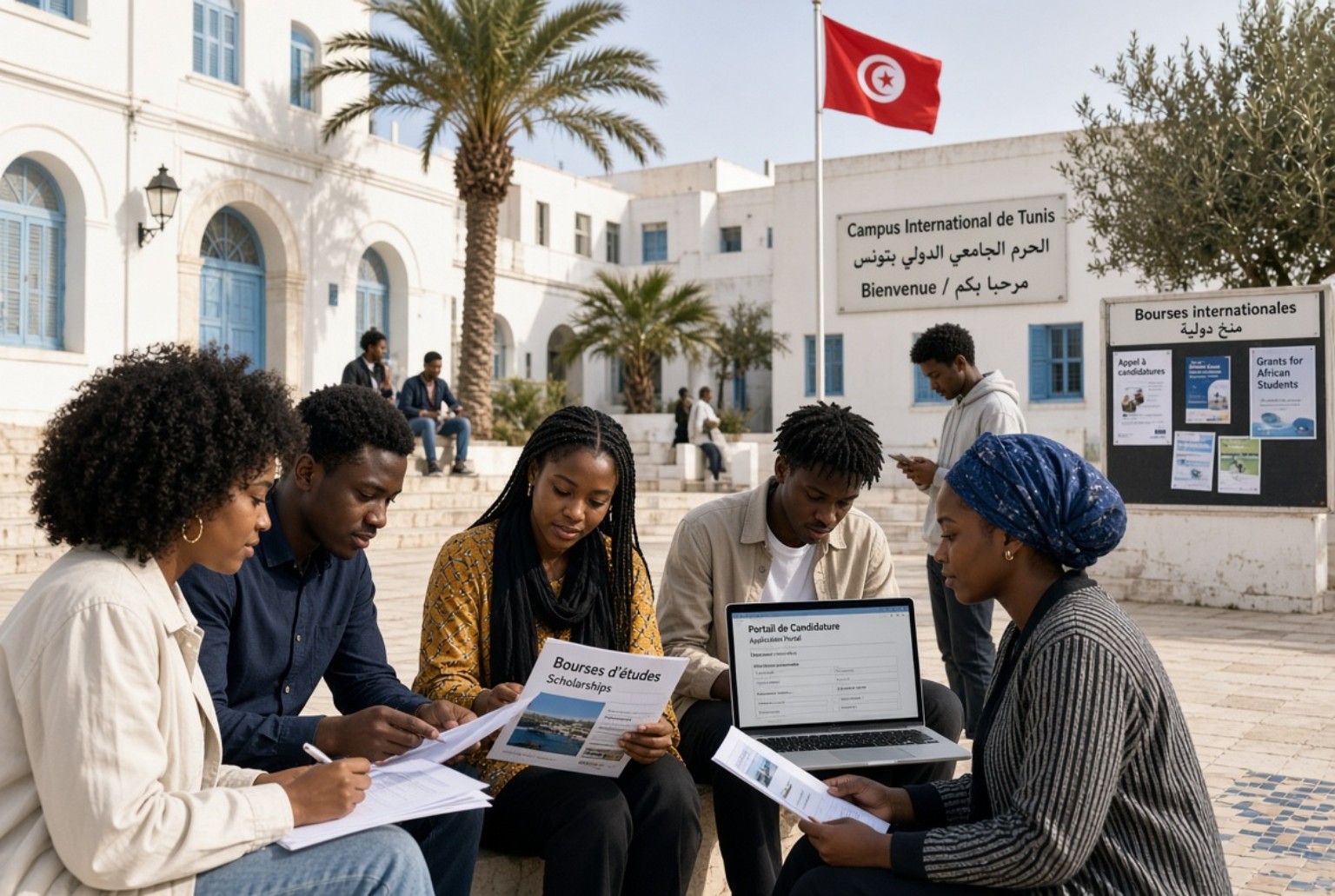
Last verified: 24 September 2026. Scholarship availability in Tunisia varies by nationality, institution, study level and bilateral agreement. Always confirm the current call through the official scholarship provider, your home-country education ministry or the Tunisian Ministry of Higher Education before applying.
2026/2027 Status
There is no single Tunisia scholarship application that is automatically open to every African student. Funding is usually accessed through country-specific bilateral awards, university scholarships, institutional fee reductions, or other mobility schemes. Some 2026/2027 government-backed calls have already closed, while other admission and institutional funding routes may still be available.
Tunisia is an established higher-education destination for students from across Africa, but scholarship information can be confusing because several different funding systems operate at the same time.
An applicant from Kenya, Nigeria, Ghana, Cameroon, Senegal or another African country may not have access to the same scholarship route, even when all are applying to universities in Tunisia.
This guide explains the main scholarship and funding routes for African students in Tunisia for 2026/2027, how bilateral awards differ from university scholarships, how international students can apply to Tunisian public universities, and what to verify before accepting an offer.
Are There Scholarships in Tunisia for African Students?
Yes. African students can access scholarships and other forms of financial support for study in Tunisia, but eligibility is not uniform across the continent.
Funding generally falls into four categories:
- Bilateral government scholarships allocated to particular African countries
- University or institution-level merit and social scholarships
- Partial tuition reductions offered by private institutions
- Mobility, exchange, postgraduate or field-specific funding programmes
The most important first step is therefore to identify which route applies to your nationality and programme, rather than searching only for a generic phrase such as “fully funded Tunisia scholarship.”
1. Bilateral Tunisia Scholarships for African Countries
One of the clearest routes into funded study in Tunisia is through bilateral education agreements between Tunisia and other African governments.
These awards are often announced by the applicant’s home-country ministry of education, scholarship board or foreign affairs authority rather than through one central application portal for all African students.
Example: Kenya–Tunisia Scholarships for 2026/2027
Kenya’s Ministry of Education officially listed Scholarships in Tunisian Universities for the Academic Year 2026/2027 as an undergraduate opportunity.
The published deadline was 31 July 2026, which means that particular cycle is already closed as of this guide’s September 2026 review.
The significance of this scheme goes beyond Kenya: it demonstrates how Tunisia scholarship places can be distributed through bilateral arrangements. Students from other African countries should therefore monitor their own ministries and scholarship agencies rather than assuming a Kenyan call is open to them.
How Bilateral Scholarships Usually Work
Exact rules differ by country and year, but the process commonly involves:
- A scholarship allocation announced by the applicant’s home government
- National screening or nomination
- Submission of academic and identity documents
- Programme or university placement in Tunisia
- Final approval through the relevant diplomatic or education authorities
Applicants should read the official national announcement carefully because funding may cover only certain costs. A government scholarship should not automatically be described as “fully funded” unless the official notice confirms tuition, living allowance, accommodation, travel and other major expenses.
2. Applying Directly to Tunisian Public Universities as an International Student
Scholarship and admission are separate processes.
Tunisia’s Ministry of Higher Education and Scientific Research provides an official route for international students who want to join Tunisian public universities on a fee-paying basis.
The Ministry states that applications from international students seeking admission to public universities against payment of tuition fees are submitted electronically. Applicants can consult the Ministry’s international student information page for the current application process, international student guide and contact details.
This route is useful for students who do not receive a bilateral scholarship but still want to study in Tunisia.
However, admission through this pathway should not be confused with scholarship funding. A student may receive a place at a Tunisian public university and still be responsible for tuition and living costs.
3. University and Private-Institution Scholarships in Tunisia
Some Tunisian private institutions offer their own merit scholarships, social scholarships or fee reductions.
These awards can be particularly relevant to students applying to professional programmes where private institutions have their own admission and funding systems.
SUP SANTÉ Scholarships
SUP SANTÉ in Tunis advertises an Excellence Scholarship and a Social Scholarship. Its published scholarship information states that eligible applicants may receive partial or full tuition support depending on the award and assessment.
For students specifically considering nursing, AfricanBase has prepared a separate guide to nursing scholarships in Tunisia, including current SUP SANTÉ and TEK-care funding routes.
Partial Tuition Scholarships
Other private institutions may offer percentage-based tuition reductions. These can still be valuable, but applicants should calculate the remaining cost over the full degree rather than focusing only on the advertised percentage.
Always confirm whether a university scholarship is available to international students, whether it applies to your chosen programme, and whether it is renewable each academic year.
4. Postgraduate, Research and Mobility Funding
Students already at university level may encounter additional opportunities through international cooperation, exchange programmes, research funding and postgraduate scholarship calls. Tunisian citizens looking specifically for domestic and overseas funding can also use AfricanBase’s scholarships for Tunisian students 2026/2027 guide.
Tunisia’s Ministry of Higher Education maintains dedicated scholarship and international-cooperation pages. These include calls connected to postgraduate study, mobility and bilateral academic cooperation.
Applicants should check the study destination carefully. Some scholarships published by Tunisian universities or the Tunisian Ministry are actually intended for Tunisian students studying abroad, not foreign students coming to Tunisia.
That distinction is essential. A scholarship appearing on a Tunisian university website is not automatically a scholarship to study in Tunisia.
Who Can Apply for Scholarships in Tunisia?
There is no single eligibility profile for all Tunisia scholarships. Depending on the programme, selection may consider:
- Nationality
- Secondary-school or university results
- Year of graduation
- Language ability
- Chosen academic discipline
- Level of study
- Age limits
- Financial need
- Nomination by a home-country ministry
- Availability of scholarship places
Some bilateral undergraduate opportunities may also require applicants to have completed secondary school very recently.
Do You Need French to Study in Tunisia?
Language requirements depend on the programme and institution. French remains important across many Tunisian higher-education programmes, particularly in scientific, technical and professional fields.
Past bilateral scholarship notices for Tunisia have explicitly required strong knowledge of French. Applicants should therefore verify the teaching language of their intended programme before applying.
Do not assume that being eligible for an international scholarship removes the programme’s language requirement.
What Do Tunisia Scholarships Cover?
Coverage varies significantly.
Depending on the award, funding may include some combination of:
- Tuition fees
- Registration fees
- Monthly stipend
- University accommodation
- Meals
- Medical coverage
- Study materials
- Travel support
But applicants should never assume that all these benefits are included.
A partial tuition scholarship is not the same as a fully funded scholarship. Likewise, a government-sponsored university place may still leave the student responsible for airfare, accommodation or personal expenses.
Documents You May Need
Requirements depend on the scholarship, but African applicants should generally be ready to provide:
- Completed scholarship or admission form
- Secondary-school certificate or university degree
- Academic transcripts
- Birth certificate
- Valid passport
- Passport photographs
- Medical certificate where required
- Language evidence if requested
- Certified translations
- Motivation letter or study plan
- Recommendation letters for some postgraduate programmes
If you are preparing several applications at once, AfricanBase’s step-by-step study-abroad scholarship application guide can help you organise documents and deadlines.
How to Find a Tunisia Scholarship for Your Country
Because many Tunisia scholarships are nationality-specific, use a country-first search strategy.
- Check your national Ministry of Education or scholarship authority.
- Search your country’s foreign affairs ministry for Tunisia education agreements.
- Check the Tunisian embassy responsible for your country.
- Review the Tunisian Ministry of Higher Education’s international student pages.
- Check the official website of the Tunisian university you want to attend.
- Verify whether the scholarship is open to your nationality and study level.
- Confirm exactly what costs are covered before accepting an offer.
AfricanBase’s broader scholarship discovery guide for African students explains how to shortlist legitimate opportunities without relying on unverified scholarship lists.
Can Nigerian Students Get Scholarships to Study in Tunisia?
Potentially, yes, but Nigerian applicants should verify whether a specific 2026/2027 bilateral allocation exists before assuming that a scholarship announced for another African country is transferable to Nigeria.
Nigerian students can also investigate direct international admission to Tunisian institutions and university-specific scholarships where their qualifications and nationality are accepted.
For regulated fields such as medicine, nursing, pharmacy or allied health, applicants should also investigate professional recognition requirements before choosing a programme. AfricanBase’s guide on choosing a career path before choosing a study destination explains why this matters.
Are Tunisia Scholarships Fully Funded?
Some may provide substantial support, but applicants should not treat “Tunisia scholarship” as synonymous with “fully funded scholarship.”
Funding structures vary by bilateral agreement and institution. Some awards may cover tuition and provide additional support, while others are tuition-only or partial fee reductions.
The safest approach is to read the official funding breakdown and calculate any remaining cost yourself.
Common Mistakes to Avoid
- Applying to a scholarship that is restricted to another nationality
- Assuming admission automatically includes funding
- Calling a partial tuition discount “fully funded”
- Ignoring French or other programme language requirements
- Using old scholarship deadlines from previous cycles
- Paying an agent before verifying the opportunity through official sources
- Failing to budget for costs not covered by the award
Frequently Asked Questions
Does Tunisia offer scholarships to African students?
Yes. Scholarship routes include bilateral government awards for particular African countries and university-level scholarships or tuition reductions. Eligibility varies by nationality and programme.
Is there one Tunisia government scholarship for all African students?
No single application has been identified that is automatically open to every African nationality. Many government-supported opportunities are country-specific and distributed through bilateral agreements.
Can international students apply directly to public universities in Tunisia?
Yes. Tunisia’s Ministry of Higher Education publishes an international-student route for applicants seeking admission to public universities on a fee-paying basis.
Are there undergraduate scholarships in Tunisia?
Yes. Kenya’s Ministry of Education officially listed undergraduate Tunisia scholarships for 2026/2027, although that specific call closed on 31 July 2026. Other countries may have different allocations and deadlines.
Are there nursing scholarships in Tunisia?
Yes. Some institutions advertise scholarships or tuition support for nursing students. See AfricanBase’s dedicated Tunisia nursing scholarship guide for current examples and eligibility details.
Final Advice
Tunisia can offer meaningful scholarship and lower-cost study opportunities for African students, but the application landscape is more fragmented than in destinations with one large national scholarship portal.
The strongest strategy is to check three channels at the same time: your home government’s scholarship announcements, Tunisia’s official international-student information, and the funding pages of individual Tunisian universities.
Most importantly, separate admission, scholarship eligibility and actual funding coverage. They are three different questions, and confirming all three before making payment can prevent costly mistakes.
AfricanBase will update this page as new Tunisia scholarship calls for African students are officially announced.