Reviewed: 28 September 2026. A scholarship study plan explains what you intend to study, how you plan to approach the programme, and how the training connects to your academic or professional goals. It is not the same as a personal statement, and it is not necessarily a research proposal.
Some scholarship applications use the term loosely, so the first rule is to follow the provider’s own instructions. If the application asks for a study plan, pay attention to whether it wants a general academic plan, a semester-by-semester outline, a research-focused plan, or a combination of these.
If you are unsure how a study plan differs from an SOP or research proposal, this guide will help you separate them clearly.
What a Scholarship Study Plan Should Explain
A useful study plan usually answers five questions:
- What do you want to study?
- Why have you chosen this field or programme?
- What specific knowledge or skills do you expect to gain?
- How will you organise your study over the programme period?
- What will you do with the training afterwards?
The strongest plans are specific enough to sound credible without pretending you already know every detail of a programme you have not yet started.
Study Plan vs Statement of Purpose
A Statement of Purpose explains your academic background, current direction, programme fit and future goals. A study plan places more emphasis on what you will study and how you intend to approach the programme.
An SOP may say:
I want to strengthen my training in public health programme evaluation because my current field experience has shown me the limits of relying on activity counts without measuring outcomes.
A study plan goes further:
During the first stage of the programme, I intend to focus on epidemiology, biostatistics and health systems modules. In the later stage, I want to apply those methods through a dissertation or applied project on programme evaluation.
For the broader academic narrative, use AfricanBase’s Statement of Purpose Guide.
Study Plan vs Research Proposal
A study plan explains your overall academic pathway. A research proposal explains a specific research question, method and expected contribution.
If the scholarship asks for both, avoid repeating the same material.
- The study plan explains the broader academic journey.
- The research proposal explains the specific research project.
For research-focused applications, see AfricanBase’s Scholarship Research Proposal Guide.
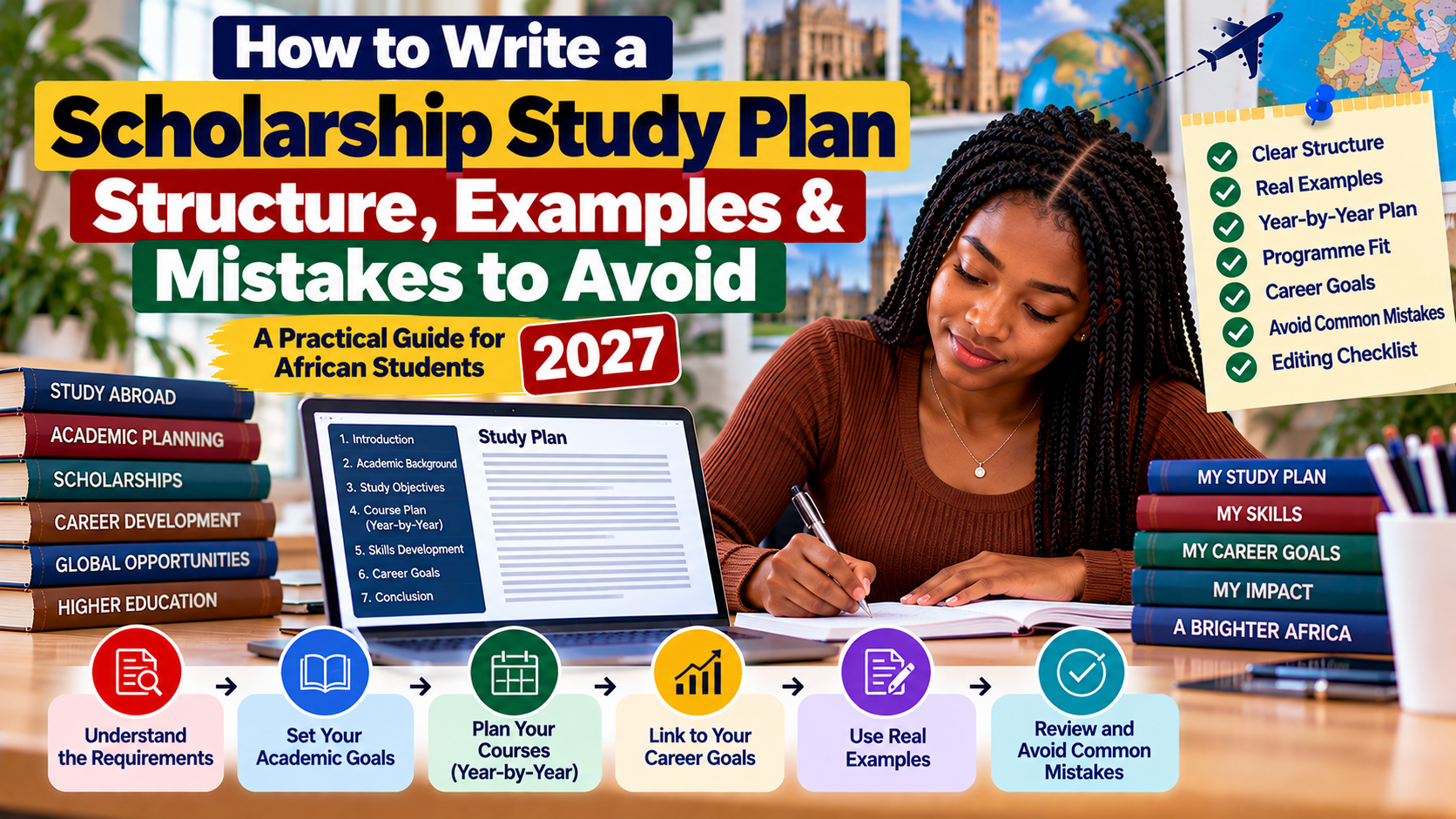
A Practical Scholarship Study Plan Structure
A clear structure usually works well:
- Academic or professional starting point
- Reason for choosing the programme
- Main learning objectives
- Programme or year-by-year study plan
- Skills and experience you expect to gain
- Post-study plan
1. Start With Your Current Academic Direction
Do not begin with a long biography.
A weak opening:
I have always dreamed of studying abroad because education is very important to me.
A stronger opening:
My undergraduate training in public health introduced me to health promotion and community-based interventions, but my strongest interest developed around how programmes are evaluated and improved using data.
The second version gives the reader a real academic starting point.
2. Explain Why You Chose the Programme
This section should connect the programme to a gap in your current knowledge or experience.
For example:
I am seeking postgraduate training because my current experience is strongest in field implementation, while I need deeper training in epidemiology, statistics and evaluation methods to move into programme monitoring and analysis.
Avoid praising the university without explaining why its programme matters to you.
3. Set Clear Learning Objectives
Your objectives should describe what you want to understand or be able to do by the end of the programme.
Examples:
- develop stronger quantitative analysis skills;
- understand advanced epidemiological methods;
- learn how to design and evaluate public health interventions;
- build competence in research design;
- strengthen academic writing and evidence appraisal;
- gain practical experience through projects or placements.
Avoid objectives such as “become the best student” or “gain international exposure.” Those are too broad to guide a study plan.
4. Explain How You Will Approach the Programme
If the scholarship asks for a detailed study plan, organise the programme into stages.
Example: One-Year Master’s Programme
| Period | Study focus |
|---|---|
| First term | Core modules and academic-methods foundation |
| Second term | Specialist modules and applied coursework |
| Final stage | Dissertation, capstone or applied project |
Example: Two-Year Programme
| Stage | Study focus |
|---|---|
| Year 1 | Core theory, methods and foundational modules |
| Year 2 | Specialisation, advanced modules, research and final project |
Do not invent course titles. Use the programme’s published curriculum when available.
5. Show How the Courses Connect
A good study plan does more than list modules.
For example:
I would first strengthen my statistical foundation through biostatistics and epidemiology modules, then apply those methods in programme evaluation coursework before using them in my dissertation.
This sounds more thoughtful than copying the programme page into your application.
6. Explain the Skills You Expect to Gain
Scholarship reviewers usually want to know what the study will enable you to do afterwards.
Depending on the field, you might highlight:
- research skills;
- data analysis;
- laboratory methods;
- policy analysis;
- technical design;
- project management;
- professional practice;
- academic writing;
- leadership or teamwork.
Keep the skills relevant to the actual programme.
7. Connect the Study Plan to Your Career Goals
The post-study plan should be realistic.
Weak:
After graduation, I will change Africa and solve major problems in my country.
Stronger:
After graduation, I plan to return to Nigeria and work in public health programme monitoring and evaluation, initially within a government agency or development organisation. My longer-term goal is to contribute to stronger use of data in maternal and child health programming.
The second version explains a pathway rather than making a broad promise.
Full Scholarship Study Plan Framework
Use this as a planning structure, not as a script to copy.
Paragraph 1 — Academic background
Briefly explain your current field and the experience that shaped your study direction.Paragraph 2 — Programme choice
Explain why this programme is the right next step.Paragraph 3 — Learning objectives
Identify the knowledge and skills you want to gain.Paragraph 4 — Study structure
Explain how you plan to approach the programme over the study period.Paragraph 5 — Application and future plan
Show how you will use the training after graduation.
Sample Study Plan: Public Health
My undergraduate training in public health introduced me to community health education and basic epidemiology. Through fieldwork, I became increasingly interested in how public health programmes are monitored and whether interventions produce measurable change.
I am applying for postgraduate study to strengthen my skills in epidemiology, biostatistics and programme evaluation. During the first stage of the programme, I intend to focus on core methods courses that will improve my ability to interpret health data and assess programme outcomes.
In the later stage, I want to apply those skills through specialised modules and a dissertation focused on maternal or youth health programming. I also plan to develop stronger academic writing and evidence-appraisal skills.
After completing the programme, I intend to return to Nigeria and work in monitoring and evaluation within public health programming, with a long-term interest in improving how community health interventions are designed and assessed.
Sample Study Plan: Engineering
My undergraduate work in electrical engineering gave me a foundation in circuits, electronics and embedded systems. My final-year project introduced me to low-cost energy monitoring, which led to a stronger interest in intelligent energy systems.
During postgraduate study, I plan to strengthen my knowledge of power electronics, control systems and smart-grid technologies. I want to begin with advanced technical modules, then move into applied project work that allows me to test those concepts in practical settings.
My goal is to develop the technical depth needed to work on affordable energy-monitoring and control systems for small businesses and public facilities in Nigeria.
Undergraduate Study Plan vs Postgraduate Study Plan
Undergraduate applicants
An undergraduate study plan may focus more on:
- why you chose the field;
- how you will build a strong academic foundation;
- skills you want to develop;
- extracurricular or practical learning;
- career direction.
Postgraduate applicants
A postgraduate study plan may need more detail on:
- specialisation;
- methods training;
- research interests;
- dissertation or capstone plans;
- professional application after graduation.
Study Plan for China Scholarships and Similar Applications
Some scholarship and university applications, including programmes in China, may request a study plan, study proposal or research plan. The wording and expected length can differ by institution and study level.
Do not assume every Chinese scholarship uses the same format. Check the university and scholarship instructions for the current cycle.
When no detailed template is provided, a useful study plan can still cover:
- academic background;
- reason for choosing the field;
- reason for choosing the institution or country;
- study objectives;
- planned academic focus;
- future career plan.
For China-specific funding routes, use AfricanBase’s China Scholarship Guide and always verify the current university instructions.
How Long Should a Scholarship Study Plan Be?
Use the scholarship’s stated word or page limit.
If no limit is provided, keep the plan focused. A clear one- or two-page plan is often more useful than a long document that repeats your personal statement.
Common Study Plan Mistakes
- Repeating the personal statement word for word.
- Listing modules without explaining why they matter.
- Using one generic plan for every scholarship.
- Inventing course content.
- Writing vague learning goals.
- Making unrealistic career promises.
- Ignoring the programme length or structure.
- Confusing a study plan with a research proposal.
- Submitting outdated course names.
- Writing more about the country than the programme.
How to Avoid Generic or AI-Sounding Writing
Be careful with phrases such as:
- “This prestigious scholarship will help me achieve my dreams.”
- “I have always been passionate about education.”
- “This programme perfectly aligns with my aspirations.”
- “I want to make a positive impact on society.”
- “Studying abroad will broaden my horizons.”
Replace broad language with specifics:
- what you need to learn;
- which part of the programme teaches it;
- how you will use it;
- what realistic role you want to move into afterwards.
How the Study Plan Should Match Your Other Documents
Your study plan should agree with your CV, SOP and personal statement.
For example:
- the CV shows what you have already done;
- the personal statement explains how those experiences shaped you;
- the SOP explains your academic direction;
- the study plan explains how you intend to use the programme;
- the research proposal explains a specific research question where required.
Use AfricanBase’s Scholarship CV Guide, Personal Statement Guide and SOP Guide to keep the application consistent.
Final Study Plan Checklist
- Did I explain what I want to study?
- Did I explain why this programme fits my needs?
- Are my learning objectives clear?
- Did I explain how I will approach the programme?
- Did I avoid copying the course page?
- Is my post-study plan realistic?
- Does the study plan match my SOP and CV?
- Did I stay within the word or page limit?
- Are programme and module names current?
- Did I remove vague and generic claims?
Frequently Asked Questions
Is a study plan the same as an SOP?
No. They overlap, but an SOP usually focuses more on your academic background, programme fit and direction, while a study plan focuses more on what you intend to study and how you will approach the programme.
Do all scholarships require a study plan?
No. Some ask for essays, an SOP, motivation letter or research proposal instead.
Can I reuse the same study plan?
You can reuse your core goals, but the final version should reflect the actual programme structure and scholarship requirements.
Should I include a research topic?
Only if the programme asks for one or if research is a major part of the degree. Otherwise, keep the plan focused on study objectives and academic progression.
Can AI help edit a study plan?
Where the provider permits it, AI can help identify repetition or unclear wording. Your academic goals, programme details and claims must remain accurate and genuinely yours.
Final Advice
A strong study plan shows that you have thought beyond admission.
Explain what you need to learn, how the programme will help you learn it, and what you intend to do afterwards. Keep the plan specific, realistic and consistent with the rest of your application.
Continue with AfricanBase’s Statement of Purpose Guide, Research Proposal Guide, Personal Statement Guide and Application Documents Checklist.