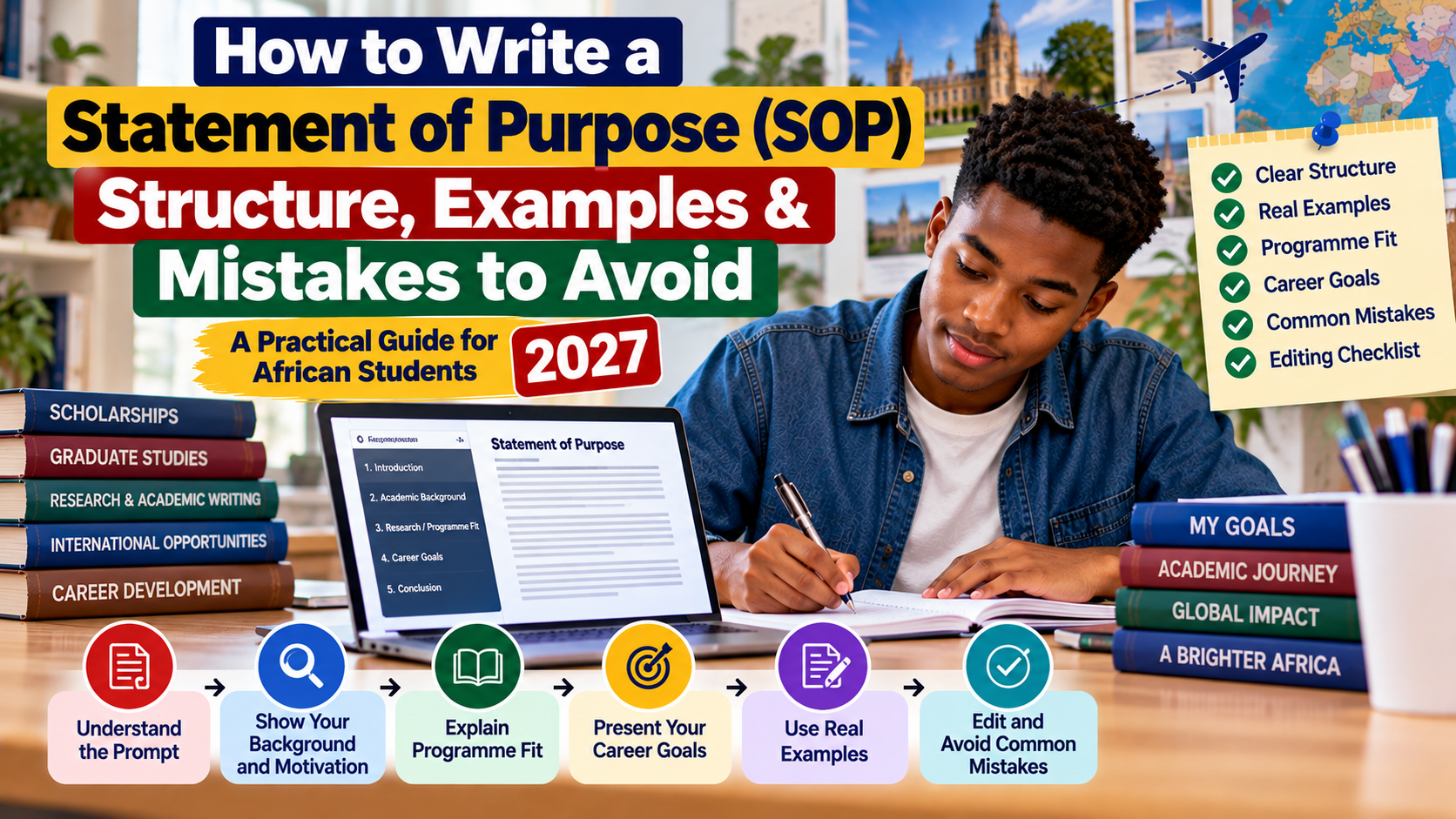
Reviewed: 28 September 2026. A Statement of Purpose (SOP) is one of the easiest application documents to misunderstand. Many applicants turn it into a life story, repeat their CV, or write a generic essay about ambition. That usually misses the point.
An SOP is mainly about academic and professional direction. It should help a university or scholarship committee understand what you have studied, what you want to study next, why the programme fits that direction, and what you plan to do with the training.
If you are still unsure about the difference between an SOP, a motivation letter and a personal statement, start with AfricanBase’s Motivation Letter vs Personal Statement vs SOP guide.
What a Statement of Purpose Should Explain
A useful SOP normally answers five questions:
- What academic or professional background do you already have?
- What topic, problem or field now interests you?
- Why do you need further study?
- Why is this particular programme a good fit?
- What do you intend to do after the programme?
The strongest SOPs make those answers feel connected rather than presenting them as separate blocks.
SOP vs Personal Statement
The distinction is mostly about emphasis.
A personal statement often gives more room to explain your background, experiences and personal development. An SOP usually gives more weight to academic preparation, programme fit, research interests and future study or career direction.
Some universities use the terms loosely. Always follow the actual prompt rather than relying only on the document title.
A Practical SOP Structure
You do not need a dramatic formula. A clear structure usually works better:
- Academic or professional starting point
- Relevant experience and preparation
- The gap you now need to address
- Why this programme fits that need
- Your future direction
1. Start With Your Academic or Professional Direction
A weak opening often sounds like this:
Since childhood, I have always dreamed of studying abroad and becoming successful in my chosen field.
That does not tell the reviewer much.
A stronger opening gives immediate context:
My interest in health systems research developed during my undergraduate public health training, where I became particularly interested in why well-designed programmes can still produce uneven outcomes across communities.
The second version gives the reader a real academic direction.
2. Show Relevant Preparation
Your SOP should explain how your previous study, work, research or projects prepared you for the programme.
This does not mean repeating your transcript or CV.
Instead of listing everything you have done, select the experiences that are most relevant.
For example:
During my final-year project, I worked with survey data on health-seeking behaviour and became more interested in programme evaluation. The project introduced me to basic quantitative analysis, but it also showed me the limits of my current methodological training.
That paragraph does more than list a project. It shows how the experience created the need for further study.
3. Explain the Academic Gap
This is one of the most useful parts of an SOP and one many applicants skip.
The reviewer should understand what you still need to learn.
For example:
My current experience is strongest in field implementation, but I need deeper training in epidemiological methods, statistical analysis and programme evaluation if I am to move into evidence-based public health planning.
This makes the next section—programme fit—much easier to write.
4. Explain Why the Programme Fits
Avoid generic lines such as:
Your prestigious university is internationally recognised for excellence.
Instead, identify programme features that matter to your goals:
- specific modules;
- research groups;
- faculty expertise;
- laboratory facilities;
- field placements;
- industry or policy partnerships;
- dissertation structure;
- methodological training.
Then explain the connection.
For example:
The programme’s modules in advanced epidemiology and health programme evaluation are directly relevant to the methodological gap I have identified in my current work. I am also interested in the dissertation component because it would allow me to apply those methods to a real public health problem.
5. Write a Future Plan That Sounds Credible
Your career plan should feel connected to your background and the programme.
Avoid very broad claims such as:
I want to transform healthcare across Africa.
A more credible version could be:
After completing the programme, I plan to work in public health monitoring and evaluation in Nigeria, with an initial focus on maternal and child health programmes. Over time, I want to contribute to stronger use of routine health data in programme design and evaluation.
Specificity makes the plan easier to believe.
A Full SOP Framework
Use this as a planning structure, not as a script to copy.
Paragraph 1 — Academic direction
Introduce the field or problem that currently interests you and explain how that interest developed.Paragraph 2 — Preparation
Show the study, research, work or project experience that prepared you for advanced study.Paragraph 3 — Current gap
Explain what skills, methods or knowledge you still need.Paragraph 4 — Programme fit
Connect specific parts of the programme to that gap.Paragraph 5 — Future direction
Explain what you plan to do after graduation and how the programme fits that pathway.
SOP Example: Public Health Applicant
My interest in public health developed through community outreach work during my undergraduate training, where I observed that many health interventions were implemented without strong systems for measuring whether they produced lasting behavioural change.
During my final-year project, I analysed survey data on healthcare utilisation and gained practical experience with data cleaning and descriptive analysis. That project strengthened my interest in programme evaluation but also made clear that I need more advanced training in epidemiology, biostatistics and implementation research.
I am applying to the MSc Public Health programme because its emphasis on epidemiological methods and health systems research directly addresses those gaps. I am particularly interested in the programme’s applied research component, which would allow me to work with real-world datasets and develop stronger evaluation skills.
After graduation, I intend to work in public health monitoring and evaluation in Nigeria, initially with a government health agency or development organisation. My longer-term goal is to contribute to stronger evidence use in maternal and child health programming.
SOP Example: Engineering Applicant
My undergraduate training in electrical engineering introduced me to embedded systems and power electronics, but my strongest interest developed while working on a final-year project involving low-cost energy monitoring.
The project required me to integrate sensors, basic control logic and data collection, and it exposed me to the practical limits of designing reliable systems for environments with unstable power supply.
I now want deeper training in intelligent energy systems and embedded control. The programme’s modules in power electronics and smart-grid technologies, combined with its applied research component, would help me develop the technical depth needed for that work.
My immediate goal is to work on affordable energy-monitoring and control systems for small businesses and public facilities in Nigeria.
Should You Mention a Professor or Supervisor?
Only when it is genuinely relevant.
For research-focused programmes, it can be useful to mention a faculty member whose work aligns with your proposed area. But do not name-drop professors simply to make the SOP sound researched.
If you mention someone, explain the specific connection between their research and your interests.
How Long Should an SOP Be?
Follow the programme’s word or page limit first.
If no limit is given, keep the document focused. Many strong SOPs are relatively concise because they avoid biography, repetition and unrelated achievements.
Do not assume that a longer SOP appears more serious.
Should You Mention Low Grades or Academic Problems?
Only when the issue is significant and the application gives you no better place to explain it.
If you do address it:
- keep the explanation factual;
- avoid sounding defensive;
- show what changed;
- point to later evidence of readiness where possible.
Do not let one academic difficulty dominate the entire SOP.
Common SOP Mistakes
- Turning the SOP into a life story.
- Repeating the CV line by line.
- Using one SOP for every university.
- Praising the institution without explaining programme fit.
- Writing vague career goals.
- Listing modules without explaining why they matter.
- Using dramatic hardship stories that do not relate to the academic purpose.
- Copying sample SOPs online.
- Using AI-generated experiences or fabricated research interests.
- Ignoring the programme’s exact prompt or word limit.
How to Make an SOP Sound Natural
Generic phrases are one of the quickest ways to make an SOP feel artificial.
Be cautious with lines such as:
- “I have always been passionate about…”
- “This prestigious institution will help me achieve my dreams.”
- “I strongly believe I am the ideal candidate.”
- “I want to make a positive impact on society.”
- “This programme perfectly aligns with my aspirations.”
Replace them with real experiences, specific programme details and concrete plans.
SOP vs Scholarship Motivation Letter
An SOP usually gives more weight to academic preparation, research or professional direction and programme fit. A motivation letter often gives more weight to why you want the opportunity and what motivates you to pursue it.
There is overlap, and some programmes use the terms interchangeably.
For the practical writing difference, see AfricanBase’s Scholarship Motivation Letter Guide.
How Your SOP Should Match Your CV
Your CV and SOP should agree on dates, roles, projects and achievements.
The difference is that:
- the CV records the facts;
- the SOP explains why selected facts matter to your academic direction.
Use AfricanBase’s Scholarship CV Guide to keep both documents aligned.
Final SOP Editing Checklist
- Does the opening establish a clear academic direction?
- Did I choose only the most relevant experiences?
- Did I explain what I still need to learn?
- Did I mention specific programme features for a reason?
- Is my future plan realistic?
- Does the SOP match my CV and application form?
- Have I removed generic praise and stock phrases?
- Did I stay within the word limit?
- Are all programme, faculty and course names correct?
- Does every paragraph help answer why I am prepared for this programme?
Frequently Asked Questions
Is an SOP required for every scholarship?
No. Some scholarships ask for essays, motivation letters or personal statements instead. Follow the exact document list for each application.
Can I use the same SOP for several universities?
You can reuse your core evidence, but the final SOP should be tailored to each programme’s curriculum, research focus and prompt.
Should I include personal hardship?
Only if it is relevant to your academic development or the prompt. The SOP should remain focused on preparation, fit and future direction.
Can AI help edit an SOP?
Where programme rules permit it, AI can help identify repetition, unclear wording or structural problems. Your experiences, research interests and claims must remain accurate and genuinely yours.
Should I use headings inside an SOP?
Only if the programme allows or requests them. Many SOPs are submitted as continuous prose.
Final Advice
A strong SOP does not try to sound impressive in every sentence. It makes your academic direction easy to follow.
Show what prepared you, identify the gap you need to address, explain why the programme fits that need, and describe the next step you intend to take. That is the core of a credible Statement of Purpose.
Continue with AfricanBase’s SOP comparison guide, Scholarship CV Guide, and Application Documents Checklist.