Reviewed: 28 September 2026. A research proposal is not just a summary of a topic you find interesting. It is a short argument showing that you have identified a meaningful problem, that the question is researchable, and that you understand how you might investigate it.
For scholarship and postgraduate applications, the proposal also helps reviewers judge whether your interests fit the programme, department, supervisor or funding scheme.
If your application also requires an SOP, use AfricanBase’s Statement of Purpose Guide so the two documents support each other without repeating the same content.
What a Scholarship Research Proposal Should Show
A strong proposal should make five things clear:
- what problem you want to study;
- why the problem matters;
- what is already known;
- what you want to find out;
- how you plan to investigate it.
For competitive scholarships, the reviewer may also look for evidence that the project is feasible within the programme’s time, resources and supervision.
Research Proposal vs Statement of Purpose
The SOP explains your academic direction, preparation and programme fit. The research proposal explains the specific research problem you want to investigate.
There is some overlap, but the emphasis is different.
Your SOP may say:
I want to develop stronger skills in public health programme evaluation because my previous work exposed gaps in how community interventions are measured.
Your proposal goes further:
This study will examine whether community health education delivered through primary healthcare centres improves maternal-health knowledge among first-time mothers in selected local government areas.
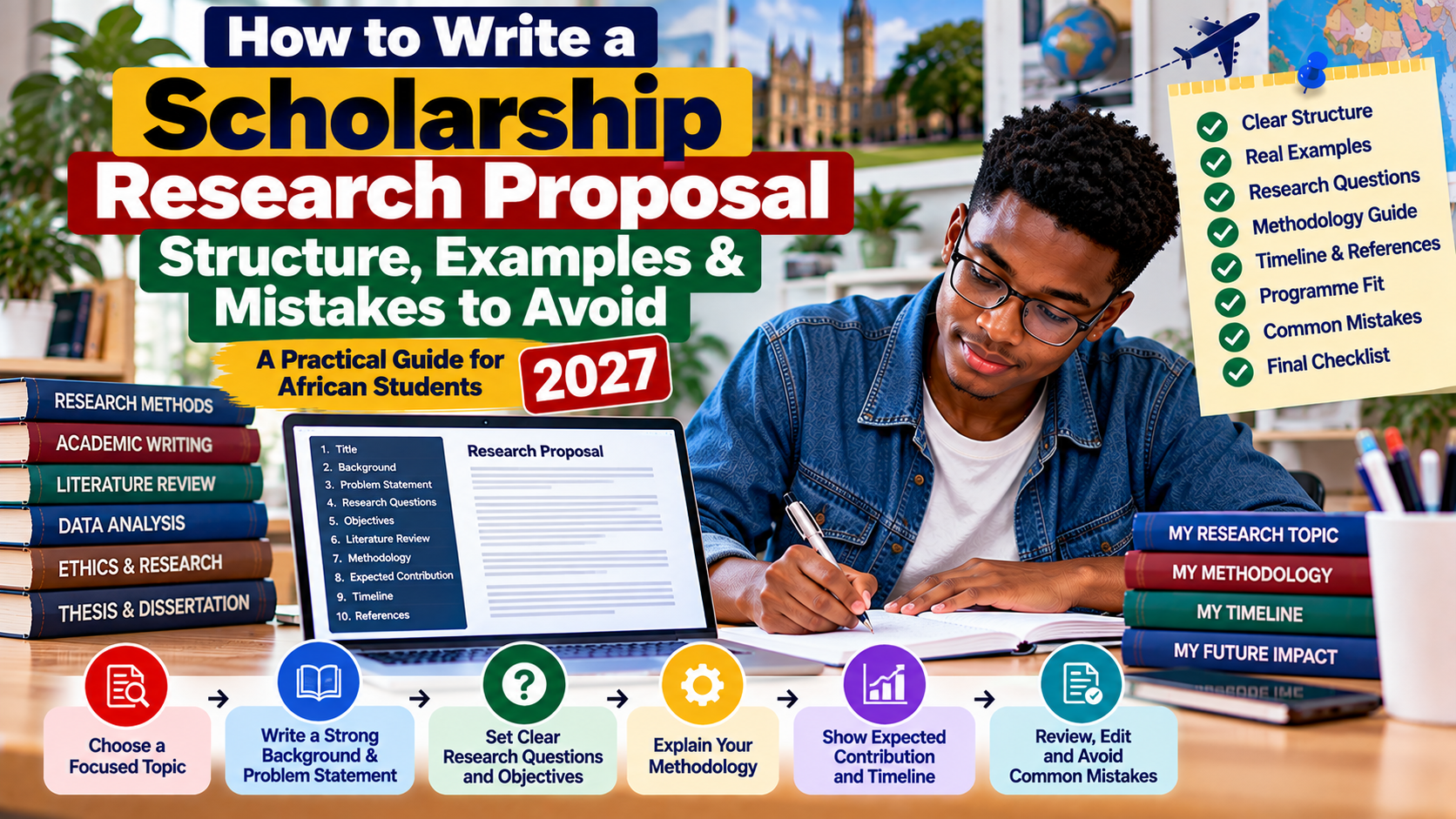
A Practical Research Proposal Structure
Requirements vary, but many proposals contain the following:
- Title
- Background or introduction
- Research problem
- Research question or objectives
- Brief literature context
- Methodology
- Expected contribution
- Timeline
- References
Use the scholarship or university’s exact structure if one is provided.
1. Write a Focused Title
A weak title is too broad:
Health Problems in Nigeria
A stronger title narrows the population, issue and context:
Maternal Health Knowledge Among First-Time Mothers Attending Primary Healthcare Centres in Enugu State, Nigeria
The exact wording may change as your project develops, but the title should help the reader understand the proposed study quickly.
2. Explain the Background
The background introduces the issue and moves from broad context toward the specific problem.
A good background usually explains:
- what the issue is;
- who is affected;
- why it matters;
- what the current evidence suggests;
- where an unanswered question remains.
Avoid spending half the proposal explaining the entire history of the field.
3. State the Research Problem Clearly
The research problem is the gap your study addresses.
Weak:
Maternal health is a serious problem in Africa.
Stronger:
Although maternal-health education is routinely delivered through primary healthcare facilities, there is limited local evidence on whether first-time mothers retain and apply key information on danger signs, antenatal attendance and birth preparedness.
The second version is narrower and researchable.
4. Write a Research Question or Objectives
Your research question should be specific enough to guide the study.
Example:
What is the level of maternal-health knowledge among first-time mothers attending selected primary healthcare centres in Enugu State?
Possible objectives could include:
- assess maternal-health knowledge among participants;
- identify the main sources of health information;
- examine whether antenatal attendance is associated with higher knowledge scores.
Do not write ten objectives for a small master’s project.
5. Give Enough Literature Context
A scholarship proposal usually does not need a full thesis literature review.
Use the literature section to show:
- what previous studies have found;
- where findings disagree;
- what population or context is under-studied;
- why your question is still worth asking.
Prioritise credible and recent sources where appropriate, while still citing important foundational work when needed.
6. Explain the Methodology
The methodology should show that the project is workable.
Depending on the study, explain:
- research design;
- study population;
- sampling approach;
- data collection;
- variables or themes;
- analysis method;
- ethical considerations.
For example:
The study will use a cross-sectional survey design. Participants will be first-time mothers attending selected primary healthcare centres. Data will be collected using a structured questionnaire and analysed using descriptive statistics and appropriate tests of association.
Do not claim advanced methods you do not understand just to make the proposal sound sophisticated.
7. Explain the Expected Contribution
This section should answer: What could we understand better if this study is completed?
Avoid exaggerated claims such as:
This research will solve maternal mortality in Nigeria.
A more realistic contribution might be:
The findings could help local health educators identify knowledge gaps among first-time mothers and improve the content or delivery of maternal-health education at primary healthcare level.
8. Add a Realistic Timeline
For scholarship applications, a short timeline helps demonstrate feasibility.
| Stage | Estimated period |
|---|---|
| Literature review and proposal refinement | Month 1–2 |
| Ethics and field preparation | Month 3 |
| Data collection | Month 4–5 |
| Analysis | Month 6 |
| Writing and revision | Month 7–8 |
Adjust the timeline to the actual programme.
9. Use References Properly
Use the citation style requested by the programme. If none is specified, choose a standard academic style and use it consistently.
Do not include references you have not actually read or sources that do not support the claims you make.
Research Proposal Example Framework
Title
A focused title that identifies the issue, population and context.Background
Brief context showing why the issue matters and what is already known.Research Problem
The specific gap your study addresses.Research Question / Objectives
One main question and a small number of clear objectives.Literature Context
Key findings from existing research and the gap that remains.Methodology
Design, participants, sampling, data collection and analysis.Expected Contribution
What the study could add to knowledge or practice.Timeline
A realistic plan for completing the project.References
Relevant academic sources in a consistent style.
How Long Should a Scholarship Research Proposal Be?
Follow the programme’s stated limit first.
Some applications ask for a brief concept note, while others require several pages. A PhD proposal may be much more detailed than a master’s scholarship proposal.
Do not assume that a longer proposal is better.
Should You Contact a Supervisor Before Writing?
For some research degrees, yes. For others, supervisor contact is optional or only happens after application.
Check the department’s official guidance before emailing faculty.
If you do contact a potential supervisor, send a concise message explaining your research area and why their work is relevant. Do not send a generic mass email.
How to Show Programme Fit
A scholarship proposal should not exist separately from the programme you are applying to.
Look for:
- faculty expertise;
- research centres;
- available methods training;
- relevant datasets or laboratories;
- regional or institutional strengths.
Then explain the connection naturally.
Common Research Proposal Mistakes
- Choosing a topic that is too broad.
- Writing a problem that cannot be measured or investigated.
- Using research questions that do not match the methodology.
- Proposing a project that is too large for the degree.
- Copying another student’s proposal.
- Claiming methods you do not understand.
- Using outdated or weak sources when stronger evidence is available.
- Making exaggerated claims about impact.
- Ignoring ethics.
- Submitting the same proposal to different programmes without checking fit.
How to Avoid Generic or AI-Sounding Proposal Writing
Be careful with phrases such as:
- “This groundbreaking study will revolutionise…”
- “This topic is very important in today’s world.”
- “There is a growing need to address…”
- “This research will make a significant impact on society.”
Those phrases often appear when the real research problem is not yet clear.
Replace broad claims with:
- a defined population;
- a specific gap;
- a precise question;
- a realistic method;
- a modest expected contribution.
How the Proposal Should Match Your SOP and CV
Your proposal, SOP and CV should point in the same general academic direction.
For example:
- the CV shows your research or field experience;
- the SOP explains how that experience shaped your academic direction;
- the proposal turns that direction into a specific research question.
Use AfricanBase’s Scholarship CV Guide and SOP Guide to keep the application consistent.
Final Proposal Checklist
- Is the topic narrow enough?
- Is the research problem clear?
- Do the research question and objectives match?
- Does the methodology answer the question?
- Is the project feasible?
- Did I explain why the study matters?
- Did I avoid exaggerated claims?
- Are sources relevant and correctly cited?
- Does the proposal fit the programme?
- Did I follow the word or page limit?
Frequently Asked Questions
Do all scholarships require a research proposal?
No. Research proposals are more common in research master’s, PhD and some fellowship applications. Always check the programme’s document list.
Can I use the same proposal for several universities?
You can reuse the core research idea, but the final proposal should reflect each programme’s requirements, supervision and research environment.
Do I need results in a research proposal?
No. A proposal explains what you plan to investigate. Do not invent findings.
Can I change the research topic after admission?
Sometimes. The extent depends on the programme and supervisor. Treat the proposal seriously even if later refinement is possible.
Can AI help write a research proposal?
Where programme rules permit it, AI can help with structure, clarity or editing. Your research idea, sources, methods and claims must remain accurate and genuinely understood by you.
Final Advice
A strong research proposal does not need to sound grand. It needs to sound researchable.
Define the problem, show what is already known, ask a focused question, choose a method that can answer it, and explain why the project fits the programme.
Continue with AfricanBase’s Statement of Purpose Guide, Scholarship CV Guide and Application Documents Checklist.