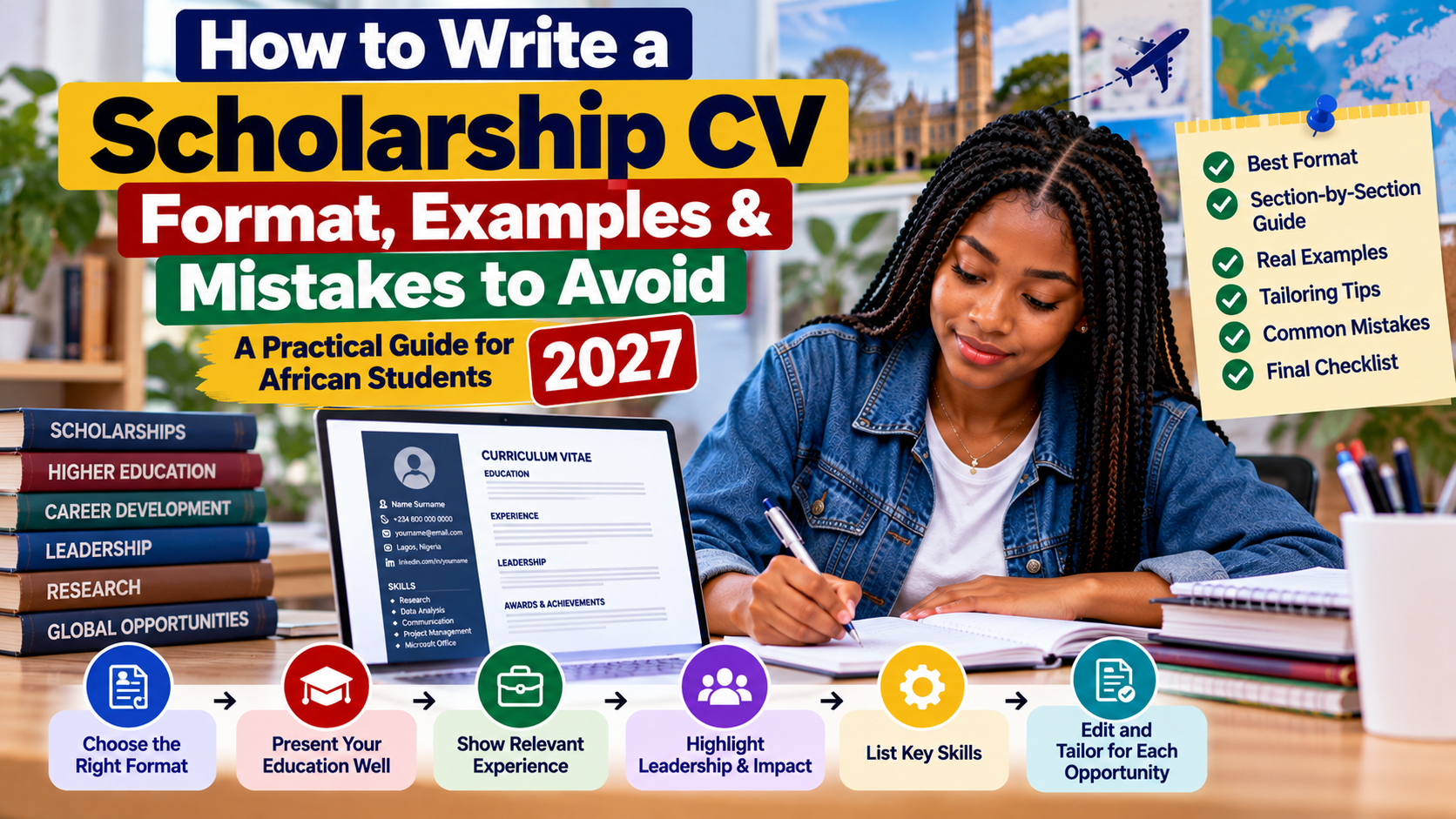
Reviewed: 28 September 2026. A scholarship CV is not simply a job résumé with the word “scholarship” added at the top. Its purpose is different. Instead of selling you for one vacancy, it helps a selection committee understand your academic record, experience, leadership, service, skills and direction at a glance.
For many applicants, the challenge is not lack of experience. It is presentation. Good work can disappear inside a weak CV if dates are unclear, achievements are vague, or every section reads like a job description.
This guide shows how to build a scholarship CV that is concise, credible and easy to review.
If you are preparing a full application pack, pair this with AfricanBase’s Scholarship Application Documents Checklist.
Scholarship CV vs Résumé: Is There a Difference?
The terms are often used loosely, and scholarship providers do not always distinguish between them. In practice:
- a résumé is usually shorter and tailored to a specific role;
- a CV can include more academic, research, publication, leadership and professional detail.
For scholarship applications, the provider’s instructions matter more than the label. If the application asks for a two-page CV, do not submit a six-page academic document simply because you call it a CV.
What Scholarship Reviewers Want to See
A strong scholarship CV makes the following easy to identify:
- what you studied;
- what you have done outside the classroom;
- what responsibilities you have held;
- what impact you have made;
- what skills are relevant to the programme;
- how your past experience connects to your future direction.
The CV should support the rest of your application, not compete with it.
A Practical Scholarship CV Structure
For most applicants, this order works well:
- Contact details
- Education
- Relevant experience
- Leadership and volunteering
- Research, projects or publications
- Awards and honours
- Skills and certifications
- Professional memberships or activities
You do not need every section. Include only what helps the reviewer understand your preparation for the opportunity.
1. Contact Details
Keep this section simple.
Usually include:
- full name;
- professional email address;
- phone number;
- city and country;
- LinkedIn profile if useful;
- portfolio or personal website if relevant.
You normally do not need to include marital status, religion, state of origin, passport number, national identification number or other sensitive personal details unless the application specifically asks for them.
2. Education
List your most recent qualification first.
A clear format looks like this:
BSc Public Health
University Name, Nigeria
2022–2026
Selected coursework: Epidemiology, Biostatistics, Health Promotion
Final project: [Title, if relevant]
If your GPA is strong and relevant, include it. If the scholarship application already captures your grades elsewhere, you do not need to force them into the CV unless they add value.
3. Relevant Experience
This section can include paid work, internships, SIWES, research assistance, clinical placement, community work or freelance projects.
The weakest style is:
Responsible for assisting with health education activities.
A stronger version is:
Supported three community health education sessions, prepared participant materials and helped document attendance and feedback from more than 80 participants.
The second version shows what actually happened.
4. Leadership and Volunteering
Scholarship committees often care about leadership, but leadership does not require a grand title.
You can include:
- student association roles;
- departmental responsibilities;
- community projects;
- peer mentoring;
- religious or civic service where relevant;
- volunteer coordination;
- campaign or outreach work.
Focus on action and outcome, not title alone.
Instead of:
President, Student Association
add context:
Coordinated a five-member executive team, organised two student support initiatives and represented departmental concerns in meetings with school management.
5. Research, Projects and Publications
This section is especially useful for postgraduate and research scholarships.
You can include:
- final-year projects;
- research assistant work;
- conference presentations;
- published articles;
- technical projects;
- policy briefs;
- software or design projects where relevant.
Do not list unfinished ideas as completed research.
6. Awards and Honours
Include awards that show academic, professional, leadership or community achievement.
For each award, write:
- award name;
- awarding organisation;
- year;
- brief context if the award is not self-explanatory.
7. Skills and Certifications
Keep this section relevant to the programme.
Useful examples may include:
- data analysis;
- laboratory methods;
- research software;
- programming;
- languages;
- project management;
- health information systems;
- digital tools;
- professional certifications.
Avoid listing vague traits such as “hardworking,” “honest” or “good communication” as standalone skills. Show those qualities through your experience instead.
How Long Should a Scholarship CV Be?
Follow the scholarship’s stated limit first.
If there is no limit, many students can present a strong scholarship CV in one or two pages. Postgraduate researchers, applicants with publications, or experienced professionals may legitimately need more space.
Length should reflect substance, not ambition.
What Should Go on Page One?
Your strongest material should appear early.
For an undergraduate applicant, that may be:
- education;
- leadership;
- community service;
- awards.
For a master’s applicant, it may be:
- education;
- relevant work;
- research or projects;
- leadership.
For a PhD applicant, research and publications may deserve more prominence than general volunteering.
How to Write Strong CV Bullet Points
A useful bullet often contains three elements:
Action + context + result.
For example:
Organised a peer tutoring programme for 25 first-year students and coordinated weekly revision sessions throughout the semester.
Or:
Analysed survey responses from 180 participants using Excel and summarised findings for a departmental research project.
Not every bullet needs a number. Use numbers when they clarify scale, not simply to decorate the sentence.
Scholarship CV Example Layout
FULL NAME
City, Country | Email | Phone | LinkedInEDUCATION
Degree, Institution — Year–Year
Relevant coursework, project or academic distinctionEXPERIENCE
Role, Organisation — Dates
• Action + contribution + outcome
• Action + responsibility + resultLEADERSHIP & VOLUNTEERING
Role, Organisation — Dates
• What you led or supported
• What changed because of your contributionRESEARCH / PROJECTS
Project title — Date
• Topic, method or contributionAWARDS
Award — Organisation — YearSKILLS
Relevant tools, methods, languages and certifications
Common Scholarship CV Mistakes
- Using one generic CV for every application.
- Writing long paragraphs instead of scannable bullets.
- Listing responsibilities without showing contribution.
- Including unrelated jobs with too much detail.
- Using decorative templates that reduce readability.
- Adding personal information the scholarship did not request.
- Using inconsistent dates.
- Claiming skills you cannot demonstrate.
- Submitting a CV with spelling errors or broken formatting.
- Calling routine participation “leadership” without explaining your role.
Should You Use a Photo?
Only if the scholarship, university or local application convention specifically asks for one.
For many international scholarship applications, a photo is unnecessary and may take up valuable space.
Should You Add References to the CV?
Usually not unless requested.
If the scholarship requires referees, it will normally collect their details separately. Use AfricanBase’s Scholarship Reference Guide to prepare that part of the application properly.
Should You Include Secondary School?
Undergraduate applicants usually should.
Graduate applicants can often omit secondary school once university education is the more relevant qualification, unless the scholarship specifically requests it.
How to Tailor Your CV Without Rewriting Everything
Keep one master CV containing all your verified experience. For each scholarship, create a shorter version that emphasises the material most relevant to the selection criteria.
If the scholarship values leadership, bring leadership examples forward. If it is research-focused, make research and technical skills easier to find.
This is not dishonesty. You are changing emphasis, not changing facts.
How the CV Should Match Your Other Documents
Your CV, essays, motivation letter and references should tell the same story from different angles.
For example:
- the CV records the leadership role;
- the essay explains a specific leadership decision;
- the motivation letter connects that experience to your next academic step;
- the reference independently supports your contribution.
Use AfricanBase’s Scholarship Motivation Letter Guide and Scholarship Essay Guide to keep those documents aligned.
File Format and Naming
PDF is often the safest format when the application allows it because it preserves layout across devices.
Use a clear filename such as:
FirstName_LastName_Scholarship_CV.pdf
If the application specifies a format or naming convention, follow that instead.
Final CV Check Before Submission
- Is the most relevant information on the first page?
- Are dates consistent?
- Are bullet points specific?
- Did I remove irrelevant detail?
- Does the CV match the application form?
- Are programme-specific skills visible?
- Have I checked spelling and formatting?
- Does the file open correctly after export?
- Did I follow the provider’s page or file-size limit?
Frequently Asked Questions
Can I use my job CV for a scholarship?
You can use it as a starting point, but scholarship applications usually benefit from more emphasis on education, leadership, research, service and academic direction.
Do I need a professional summary?
Not always. If you use one, keep it short and specific. Avoid generic summaries filled with adjectives.
Should I include hobbies?
Only if they add relevant context or achievement. General hobbies are usually lower priority than academic, professional or leadership information.
Can I include unpaid work?
Yes. Volunteer work, student leadership, community projects and unpaid research can be highly relevant if they show meaningful contribution.
Is a one-page CV too short?
Not if it contains the information the scholarship needs. Relevance matters more than length.
Final Advice
A scholarship CV should make your experience easier to understand, not make you look busier than you are.
Use clear sections, honest evidence and relevant detail. If the reviewer can quickly see what you have studied, what you have contributed and why your background fits the opportunity, the CV is doing its job.
Continue with AfricanBase’s Application Documents Checklist, Motivation Letter Guide and Reference Guide.