Reviewed: 28 September 2026. A scholarship personal statement should help a reviewer understand who you are beyond grades and job titles. It is not a full autobiography, and it should not read like a motivational speech.
The best personal statements usually do three things well: they show how your experiences shaped you, they explain why your goals make sense, and they connect your background to the opportunity you are applying for.
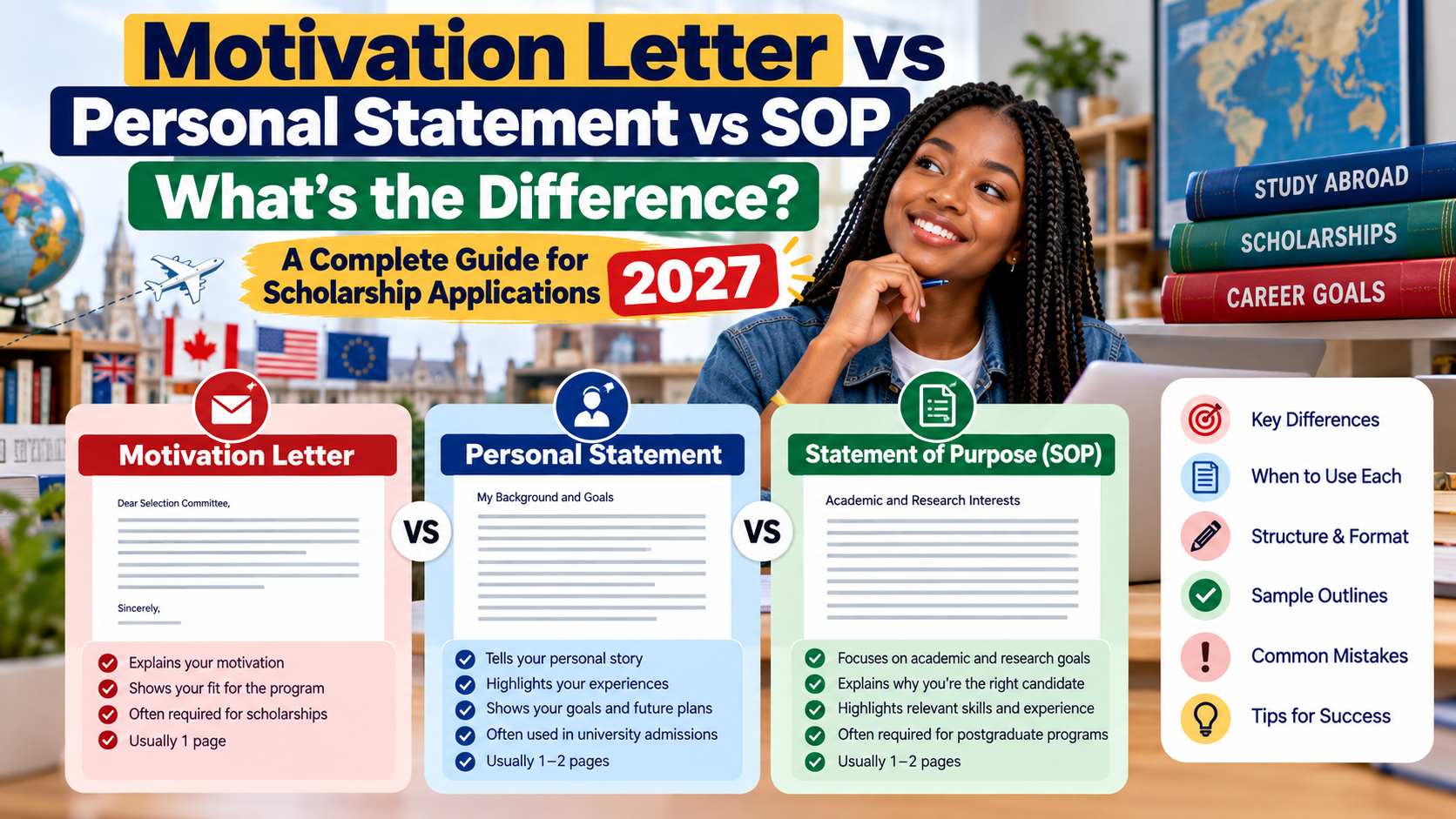
If you are unsure whether the application wants a personal statement, motivation letter or Statement of Purpose, start with AfricanBase’s Motivation Letter vs Personal Statement vs SOP guide.
What a Scholarship Personal Statement Is Really For
A personal statement gives the committee context that your transcript and CV cannot provide on their own.
It can help explain:
- what shaped your academic interests;
- what experiences influenced your goals;
- how you responded to challenges;
- what you learned from leadership or service;
- why the opportunity fits your next step;
- what you hope to do afterwards.
The key is selection. You do not need to tell the reviewer everything about your life.
Personal Statement vs Scholarship Essay
A personal statement is usually broader. It often asks the reviewer to understand your background and direction.
A scholarship essay is often narrower and tied to a specific prompt such as leadership, community impact, career goals or financial need.
That means a personal statement may use several experiences, while a scholarship essay may focus deeply on one.
For prompt-based writing, use AfricanBase’s Scholarship Essay Guide.
A Practical Personal Statement Structure
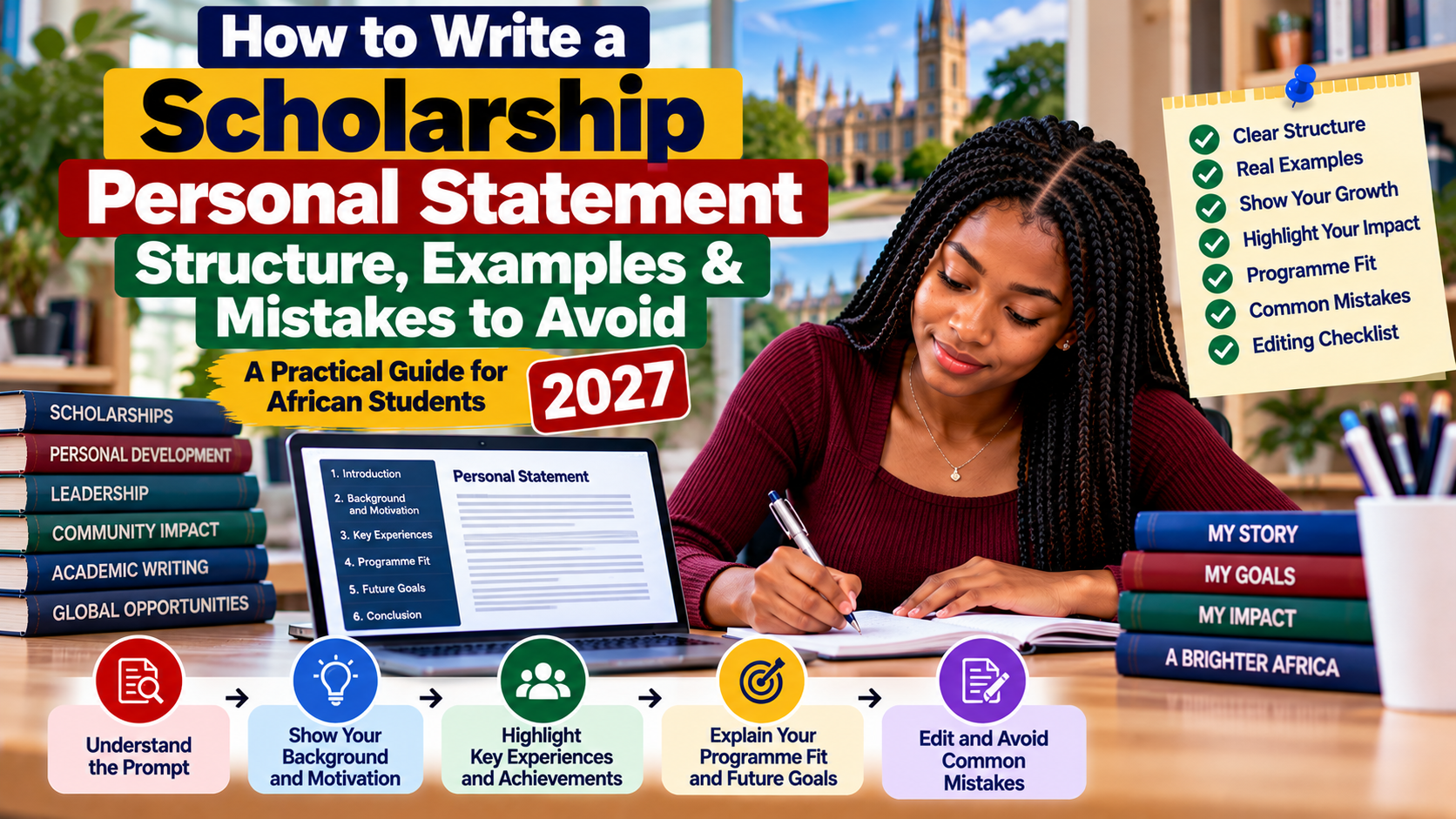
A clear structure is usually enough:
- Opening experience or direction
- Academic or personal development
- Relevant experience and evidence
- Why the opportunity fits
- Future direction
1. Open With Something Specific
A weak opening often sounds like this:
I have always been passionate about education and helping people, and I believe this scholarship will help me achieve my dreams.
The problem is not that the sentence is wrong. It is that it could belong to almost anyone.
A stronger opening gives the reviewer something concrete:
My interest in public health became more serious during a community outreach project in Enugu, where I helped record attendance and feedback from mothers attending a maternal-health education session. I began to notice that the same message was understood differently across communities, and that made me more interested in how health information is designed and evaluated.
The second version gives the reader a real starting point.
2. Explain How You Developed
A personal statement should show movement.
The reviewer should be able to see how one experience led to another.
For example:
That early interest led me to choose public health courses that focused on epidemiology and health promotion. During my final-year project, I became more comfortable working with survey data and began to see how evidence could improve community health programmes.
This is more useful than simply listing course names or saying you are “passionate.”
3. Show Evidence of What You Have Done
A personal statement becomes stronger when claims are supported by actual examples.
Instead of:
I am a strong leader and communicator.
Try:
As a student association coordinator, I organised a small team that handled orientation support for new students and worked with school staff to resolve recurring registration questions.
The second version gives the reviewer something to evaluate.
4. Explain Why This Opportunity Fits
Do not treat this section as advertising for the university.
Avoid empty praise such as:
Your prestigious institution is one of the best in the world.
Instead, explain what the opportunity gives you that you currently lack.
For example:
The scholarship would allow me to study health promotion in a programme with stronger training in behavioural science and programme evaluation. Those areas are directly relevant to the work I want to do in community health education in Nigeria.
5. End With a Credible Next Step
Your future plan does not need to sound enormous.
A realistic plan is often more convincing than a grand one.
Instead of:
I will transform healthcare across Africa.
Try:
After graduation, I hope to work in health promotion and programme evaluation in Nigeria, initially within a public health agency or development organisation. Over time, I want to help design community health interventions that are easier to measure and adapt.
Full Personal Statement Framework
Use this as a planning guide, not as a template to copy word for word.
Paragraph 1 — Starting point
Introduce the experience, question or problem that shaped your current direction.Paragraph 2 — Development
Explain how your studies, work or projects deepened that interest.Paragraph 3 — Evidence
Show a relevant example of responsibility, leadership, research, work or service.Paragraph 4 — Opportunity fit
Explain why this scholarship or programme is the right next step.Paragraph 5 — Future direction
Describe what you plan to do afterwards and how the opportunity fits that pathway.
Personal Statement Example for a Scholarship Applicant
My interest in health education grew through volunteer work during my undergraduate training, where I helped support community outreach sessions on preventive health. I noticed that people often understood health advice differently depending on how the message was delivered, and that made me more curious about communication and behaviour change.
That interest shaped the courses and projects I chose during my degree. My final-year work introduced me to basic data collection and evaluation, while student leadership roles helped me become more confident coordinating small teams and communicating with different groups.
I now want stronger training in health promotion and programme evaluation so I can move beyond delivering health messages and contribute to designing interventions that can be measured and improved.
The scholarship would make it possible for me to pursue that training in a programme that combines behavioural science with applied public health practice.
After graduation, I plan to return to Nigeria and work in community health programming, with a particular interest in maternal and youth health education.
Should You Write About Hardship?
Only when it helps explain your development or directly answers the prompt.
Hardship can provide important context, but the statement should not stop at what happened to you.
The reviewer should also understand:
- how you responded;
- what changed;
- what you learned;
- how the experience affected your direction.
A hardship story without reflection can feel incomplete.
How Personal Should a Personal Statement Be?
Personal does not mean private in every detail.
You can be honest without disclosing information that makes you uncomfortable or that is not relevant to the application.
Choose experiences because they explain your development, not because they are dramatic.
How Long Should a Personal Statement Be?
Follow the application’s word or character limit first.
If the scholarship asks for 500 words, do not submit 900. If there is no stated limit, keep the statement focused and avoid repetition.
Length is not a substitute for substance.
How to Avoid Sounding Generic
Watch for phrases such as:
- “I have always wanted to make a difference.”
- “I am passionate about helping people.”
- “This scholarship will help me achieve my dreams.”
- “I want to give back to society.”
- “I am a hardworking and determined person.”
Those ideas can be true, but the statement becomes stronger when you show the evidence behind them.
Instead of saying you care about education, explain what you have done in education. Instead of saying you are resilient, show the situation that required resilience.
Personal Statement vs SOP
A Statement of Purpose usually places more emphasis on academic preparation, research direction and programme fit.
A personal statement usually gives more room to explain your background, development and the experiences that shaped your goals.
For graduate admissions, see AfricanBase’s Statement of Purpose Guide.
Personal Statement vs Motivation Letter
A motivation letter often asks, “Why do you want this opportunity?”
A personal statement often asks, “Who are you, what shaped you, and where are you going?”
There is overlap, so the actual application prompt should always guide the final document.
Use AfricanBase’s Scholarship Motivation Letter Guide when the provider specifically asks for a motivation letter.
How Your Personal Statement Should Match Your CV
Your CV records the facts. Your personal statement gives selected facts meaning.
If your CV says you led a student project, your personal statement might explain what the experience taught you and how it shaped your goals.
Keep names, dates, roles and achievements consistent across both documents.
Use AfricanBase’s Scholarship CV Guide to prepare the factual side of the application.
Common Personal Statement Mistakes
- Trying to tell your whole life story.
- Repeating the CV line by line.
- Using one generic statement everywhere.
- Writing a dramatic story that never connects to the scholarship.
- Making broad claims without evidence.
- Using too much praise for the institution.
- Ignoring the prompt.
- Copying samples online.
- Using AI-generated experiences or achievements that are not yours.
- Forgetting to update university or scholarship names.
Final Editing Checklist
- Does the opening tell the reader something specific?
- Can the reviewer see how I developed over time?
- Did I support important claims with examples?
- Does the scholarship or programme fit make sense?
- Is my future plan realistic?
- Does the statement match my CV and application form?
- Have I removed generic phrases?
- Did I stay within the word limit?
- Have I checked names, dates and programme details?
- Does every paragraph help explain who I am and where I am going?
Frequently Asked Questions
Can I use the same personal statement for several scholarships?
You can reuse your core evidence, but the final version should be adapted to each scholarship’s prompt and selection criteria.
Should I include my GPA?
Only if it adds useful context or the application asks for it. Your transcript already records your grades.
Can I start with a quote?
You can, but it is rarely necessary. Your own experience is usually a stronger opening than a famous quotation.
Should I mention financial need?
Only if it is relevant to the scholarship or prompt. Keep it factual and connect it to the opportunity rather than turning the entire statement into a funding appeal.
Can AI help edit a personal statement?
Where the provider allows it, AI can help identify unclear wording or repetition. The experiences, claims and final story must remain accurate and genuinely yours.
Final Advice
A strong personal statement does not try to sound extraordinary. It helps the reviewer understand your development clearly.
Choose a few meaningful experiences, explain what they changed for you, connect them to the opportunity, and show where you intend to go next.
Continue with AfricanBase’s comparison guide, SOP Guide, Scholarship CV Guide, and Application Documents Checklist.