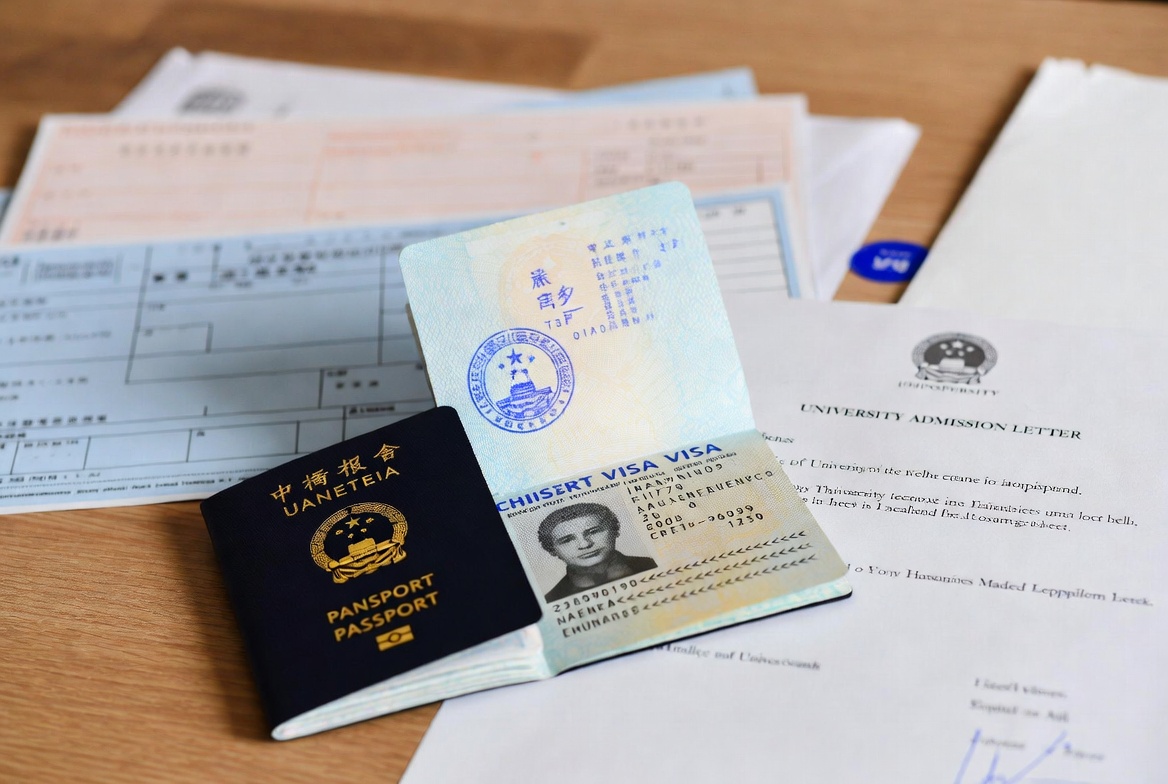
Quick answer: To apply for a Chinese student visa, you need a valid passport, an Admission Notice and the study document required for your visa category. Nigerian applicants now complete the form and upload supporting documents through the Chinese Visa Application Service Centre portal, wait for online review, and then submit their passport and original documents in person. Most degree students apply for the X1 visa (programmes over 180 days), then apply for a residence permit within 30 days of entering China.
Chinese Student Visa: At a Glance
| Question | Answer |
|---|---|
| Main visa for degree programmes over 180 days | X1 visa |
| Main visa for short-term study | X2 visa |
| Core university documents | Admission Notice and the study documentation required for the visa category |
| Nigerian application route | Complete the online process and follow the Chinese Visa Application Service Centre instructions for document submission |
| After entering China on X1 | Complete the required residence-permit process within the prescribed period |
| Guide updated for | 2026 process |
AfricanBase Verified Answer: Nigerian students should treat the X visa process as a document-verification process: the correct visa category, matching admission records, valid travel documents and the current visa-centre procedure all matter. Complete documentation reduces avoidable problems, but visa approval remains at the discretion of the relevant Chinese authorities.
If you have just received your admission letter from a Chinese university — congratulations. The visa stage is where many African students get nervous, and where avoidable mistakes cause real delays. The good news is that the Chinese student visa process is document-heavy but predictable. If your paperwork is complete and consistent, approval rates are high. This guide walks you through everything: choosing between X1 and X2, understanding the JW201/JW202 forms, gathering documents, booking your appointment, paying fees, and what you must do within your first 30 days in China.
Before You Start: How the Chinese Student Visa System Actually Works
Understanding the logic of the system makes every later step easier. Three principles drive everything:
First, your university starts the process — not you. Unlike some countries where you apply for a visa independently, the Chinese system is university-anchored. Your institution reports your admission to the authorities, and the government issues the JW201/JW202 form through official channels. You cannot begin a visa application until those documents exist. This is why choosing a university that responds quickly to emails matters more than most students realize.
Second, the visa gets you in; the residence permit keeps you there. For degree students, the X1 visa is deliberately temporary — a single-entry key to the door. Your real legal status in China is the Residence Permit for Study, issued after arrival by the Exit-Entry Administration in your university’s city. Everything about the X1 process is designed around this handover, which is why originals of your documents matter: you will present them twice, once at the embassy and once in China.
Third, consistency beats volume. Chinese visa officers are not looking for the thickest application file; they are checking that every document tells the same story — same name spelling, same program, same dates, same funding source. One inconsistency raises more questions than a missing optional document. Build your application around this principle and you have understood 80% of the game.
With that logic in mind, let’s choose your visa type.
Types of Chinese Student Visas: X1 vs X2
China issues two student visa categories, and the difference comes down to one thing: the length of your program.
| Feature | X1 Visa | X2 Visa |
|---|---|---|
| Program length | More than 180 days | 180 days or fewer |
| Typical students | Degree students (bachelor’s, master’s, PhD), long-term language students | Short courses, exchange semesters, summer programs |
| Entries | Single entry (converted after arrival) | Usually single entry |
| Residence permit required? | Yes — within 30 days of arrival | No |
| Form required | JW201 or JW202 | Short-term study information form (DQ), as required |
Who needs which visa?
- X1 visa: If you are starting a full degree program — which describes almost every African scholarship student — you need the X1. The X1 itself only lets you enter China once. After arrival, you exchange it for a Residence Permit for Study, which becomes your real long-term status and allows you to leave and re-enter China freely during your studies.
- X2 visa: Only for programs of six months or less — short language courses, exchange semesters, or summer schools. No residence permit conversion is needed.
Critical warning: Do not assume that entry on a tourist visa or under a visa-free arrangement can later be converted into student status. Apply for the appropriate X1 or X2 visa before travelling unless the Chinese immigration authority and your university give you written instructions confirming another lawful route.
X1 vs X2: Visa Validity, Entries and Length of Stay
Do not confuse the visa’s validity period with the amount of time you may remain in China. Check three separate fields on the issued visa: validity (when the visa may be used to enter), entries (how many entries are permitted), and duration of each stay (how long you may remain after an entry). X1 students subsequently rely on their study residence permit after completing the required post-arrival process.
If you plan to leave China and return during a short X2 programme, verify the number of entries before booking travel. Do not assume a single-entry visa can be reused after departure.
Understanding the JW201 and JW202 Forms
These two forms confuse more applicants than anything else in the process, so let’s make it simple.
Both are officially called the “Visa Application for Study in China” form. They are issued through Chinese government systems — you cannot download them yourself. Your university sends the form to you together with your Admission Notice.
Nigerian applicants who are still choosing a funding route can review our China scholarship guide for Nigerian students before planning their admission and visa documents.
- JW201: Issued to students on Chinese Government Scholarships (CSC) and certain Ministry of Education–affiliated programs. If you won a CSC scholarship, expect a JW201.
- JW202: Issued to self-funded students and students on other scholarship types (provincial scholarships, university scholarships, Confucius Institute scholarships in many cases).
Key facts about these forms:
- The embassy requires the original plus a copy (some universities now issue electronic versions — print them exactly as instructed by your university).
- Check every detail — name spelling, passport number, program, duration — against your passport the day you receive it. A mismatch between your JW form and your passport is one of the most common causes of visa delays. If there is any error, contact your university’s admission office immediately for a corrected form.
- Guard the original carefully. You will need it again when converting to your residence permit in China.
Eligibility Requirements
Before applying, make sure you meet these baseline conditions:
- A passport valid for at least 6 months beyond your application date, with at least one blank visa page (two is safer)
- A formal Admission Notice from a Chinese institution authorized to enroll international students
- The supporting study document required for your category: generally JW201/JW202 for X1 university study, or the short-term student information form required for X2
- Proof that you can fund your studies (or a scholarship award letter that covers them)
- A completed Foreigner Physical Examination Form for X1 applicants (details below)
- No record of previous Chinese immigration violations
Documents Required (Complete Checklist)
Prepare these before booking your appointment:
- Original passport (6+ months validity, blank pages) plus a photocopy of the data page
- Completed online visa application — Nigerian applicants use the Visa Application Service Centre portal, upload their documents for preliminary review and print the confirmation after approval
- One recent passport photo meeting Chinese visa specifications (white background, 33mm × 48mm, taken within 6 months) — most applicants also upload a digital photo during the online application process
- Admission Notice — original and copy
- JW201 or JW202 form — original and copy
- Foreigner Physical Examination Form (for X1 / long-term study) — completed at an approved hospital within the last 6 months, with stamped photo, including lab reports (blood tests, chest X-ray). Keep the originals of all lab results
- Proof of financial support — for Nigerian X1 and X2 applicants, the published embassy checklist specifies proof of US$2,500 per year or a scholarship certificate
- Previous Chinese visas if you have any (bring old passports)
- Proof of final academic qualification authenticated by Nigeria’s Federal Ministry of Education, as specified for Nigerian university applicants
- Police character certificate for the residence-permit stage — official Nigerian guidance says X1 holders need a consular-authenticated Nigerian police character certificate when applying for the residence permit after arrival
- Proof of appointment booking and visa fee payment method
Tip for Nigerian applicants: Requirements can differ slightly between the Chinese Embassy in Abuja and the Consulate-General in Lagos, and between visa application service centres. Check the specific centre’s checklist before your appointment.
Step-by-Step Visa Application Process
Step 1: Receive your admission documents
Your university sends the Admission Notice and JW201/JW202 — sometimes by courier, sometimes electronically. Verify every detail immediately.
Step 2: Complete the medical examination
For X1 applicants, complete the Foreigner Physical Examination Form at a recognized hospital. The examination typically includes a general check-up, blood tests, and a chest X-ray. The form must be stamped across your photo by the hospital. It is valid for 6 months — don’t do it too early, but don’t leave it to the last week either.
Step 3: Complete the online application
For Nigerian applicants, create an account on the Chinese Visa Application Service Centre portal, complete the online form and upload clear copies of the requested documents. Monitor your email and account during the initial review and correct or supplement anything requested. When the status changes to “Passport to be submitted,” print the confirmation and proceed to the centre with your passport and supporting documents. Applicants elsewhere should follow the portal or mission serving their country.
Step 4: Attend your appointment in person
Submit your passport and required documents at the Chinese embassy, consulate or visa application centre after the online review. In Nigeria, X1 applicants still provide fingerprints. Short-term visa applicants whose intended stay is no more than 180 days, including X2 applicants, are temporarily exempt from fingerprint collection through 31 December 2026, unless another exception or instruction applies.
Step 5: Pay the visa fee
Visa fees vary by nationality. For Nigerian regular-passport holders, the reduced government visa charge for one entry is ₦10,500 through 31 December 2026. The Chinese Visa Application Service Centre charges a separate service fee, so check the current total before submission. Express service costs more.
Step 6: Collect your passport
After the online preliminary review is approved and the passport is submitted, normal processing is usually about 4 working days, subject to the consular officer’s decision. The online review happens before this period, so applicants should allow additional time and monitor requests for corrections. Express service only accelerates the stage after physical submission.
Visa Fees and Processing Time at a Glance
| Item | Typical figure |
|---|---|
| Nigerian one-entry visa charge | ₦10,500 through 31 Dec 2026, plus visa-centre service fee |
| Standard processing | ~4 working days after passport submission, plus online review time |
| Express processing | 2–3 working days (extra fee) |
| Best time to apply | As soon as admission documents arrive; avoid late August |
| Validity to enter China | Usually must enter within 3 months of issue |
Your Visa Timeline: Working Backwards from September
Most Chinese academic programs begin in early September, with registration in the last week of August. Here is a realistic timeline that keeps you ahead of every deadline:
| When | What you should be doing |
|---|---|
| January–March | Apply to universities and scholarships (CSC deadlines fall in this window) |
| April–May | Receive admission decisions; scholarship results follow |
| May–June | Admission Notice and JW201/JW202 arrive; verify all details immediately; obtain police clearance |
| June | Complete medical examination; gather bank statements or scholarship letter; complete the online visa application and upload documents |
| Late June–early July | Book appointment; submit visa application |
| Mid-July | Collect passport with visa; book flights |
| Late August | Fly to China (enter within your visa’s validity window) |
| First 24 hours | Register your accommodation |
| First 30 days | Complete medical verification and residence permit application |
Applying in late June or early July puts you weeks ahead of the August panic, when appointment slots at busy missions like Lagos and Abuja become scarce and processing queues stretch.
A worked example
Consider a typical case: Amina, a Ghanaian student, receives a provincial scholarship at a university in Nanjing. Her Admission Notice and JW202 arrive by courier on June 3rd. That same week she books her medical examination and requests a police clearance certificate. She completes the online visa form on June 20th, cross-checking every entry against her passport and JW202, and attends her appointment in Accra on June 26th with two full photocopied document sets. Her passport is ready on July 2nd. She flies on August 24th, her university registers her dormitory address on arrival day, and her international student office schedules her residence permit appointment for September 8th — comfortably inside the 30-day window. Nothing about Amina’s case required luck; every step was sequencing.
Now compare the common failure mode: a student who waits until the JW form arrives before starting anything, does the medical exam in mid-August, discovers a name mismatch in the online visa form, and cannot get a corrected JW form and an appointment slot before registration week. Same documents, same admission — but a deferred semester. The difference is entirely in the timeline.
After You Arrive: The Residence Permit (X1 Students)
Your X1 visa is only the beginning. Within your first weeks in China you must complete three things:
- Register your accommodation within 24 hours of arrival. If you live on campus, the university usually handles this. If you live off campus, you and your landlord must register at the local police station. You receive a Temporary Residence Registration Form — keep it safe.
- Complete the medical verification. Many cities require a health check or verification of your home-country medical exam at the local International Travel Healthcare Centre.
- Apply for your Residence Permit within 30 days. Your university’s international student office will guide you through applying at the local Exit-Entry Administration Bureau. You will need your passport, Admission Notice, JW form, registration form, health certificate, and photos. The residence permit replaces your X1 visa as your legal status and allows multiple entries for its validity period (often one academic year at a time, renewed annually).
Do not miss the 30-day deadline. Overstaying an unconverted X1 visa is an immigration violation that can bring fines and jeopardize your studies before they even begin.
Common Reasons Chinese Student Visas Are Refused
Refusals are relatively rare for genuine students with complete documents, but these are the patterns behind most rejections and delays:
- Inconsistent information — details on your online application that don’t match your passport, JW form, or Admission Notice
- Name mismatches — spelling differences between your passport and university documents (a huge issue for applicants whose names were entered incorrectly during university application)
- Insufficient proof of funds — bank statements that are too recent, too small, or show sudden unexplained deposits
- Missing or expired medical form — physical examination older than 6 months or missing lab reports
- Suspected non-genuine study intent — weak academic history combined with an unrelated program choice can trigger extra scrutiny
- Fake or altered documents — an automatic refusal and potential long-term ban; never use an agent who “arranges” documents
- Applying for the wrong visa type or trying to convert status after visa-free entry
Common Mistakes to Avoid
- Waiting until your JW form arrives to start gathering other documents — begin your medical exam, police clearance, and bank statements early
- Booking flights before your visa is issued
- Doing the medical exam at a non-recognized clinic, forcing a repeat
- Losing your original Admission Notice or JW form — Chinese immigration requires originals, and replacements take weeks
- Ignoring the 24-hour registration and 30-day residence permit rules after arrival
- Assuming another student’s document list applies to you — always check your specific embassy or consulate’s current checklist
- Submitting agent-prepared forms without checking that names, passport details, course dates and funding information match your official documents
Tips for Nigerian and African Students
- Apply early in the cycle. Nigerian applicants face heavy demand at the Lagos and Abuja missions in July–August. Applying in June (or as soon as documents arrive) avoids the crush.
- Match your names everywhere. If your passport says “Chukwuemeka” and your WAEC certificate says “Chukwu Emeka,” resolve this with an affidavit before the university issues your JW form — not after.
- Prepare financial proof properly. If self-funded, keep consistent balances in the sponsoring account for several months rather than making one large last-minute deposit. If on scholarship, your award letter (CSC, provincial, or university) is your proof of funds.
- Photocopy everything twice. One full document set for the visa application, one to carry to China for the residence permit process.
- Beware of visa agents promising “guaranteed” visas. No one can guarantee a visa, and fraudulent documents end careers. The process is manageable on your own with your university’s admission office supporting you.
- Plan your arrival window. Enter China within your visa’s validity, close to your university’s registration dates, and keep your first-week schedule free for registration, medical verification, and residence permit paperwork.
Frequently Asked Questions
What is the difference between the X1 and X2 Chinese student visa? The X1 is for study programs longer than 180 days and must be converted to a residence permit within 30 days of arrival. The X2 is for programs of 180 days or fewer and needs no conversion.
What is the JW202 form and who issues it? The JW202 is a study-confirmation document issued through the relevant Chinese education system and supplied through the admitting institution. It is commonly used for self-funded students, but applicants should submit exactly the document listed by their university and visa centre for their category.
What is the difference between JW201 and JW202? JW201 goes to Chinese Government Scholarship (CSC) students and Ministry of Education–affiliated programs; JW202 goes to self-funded students and most other scholarship types. Both serve the same visa function.
How much does a Chinese student visa cost for Nigerians? The reduced government charge for a one-entry visa is ₦10,500 through 31 December 2026. The application centre’s service charge is separate and may be substantially higher, so verify the total on the Abuja or Lagos centre website before submission.
How long does a Chinese student visa take to process? Normal processing is around four working days after the passport and physical documents are submitted, subject to the consular officer’s decision. Nigeria’s online preliminary review takes place first and may add time if corrections or extra documents are requested.
Do I need a medical examination for a Chinese student visa? X1 (long-term) applicants must complete the Foreigner Physical Examination Form at an approved hospital within 6 months of applying, including blood tests and a chest X-ray.
How much money do I need to show for a Chinese student visa? There is no single published figure; you must show you can realistically cover tuition and living costs for at least your first year. A scholarship award letter that covers tuition, accommodation, and stipend satisfies this requirement.
Can I apply without a JW201/JW202 form? Nigerian X1 university applicants are asked for JW201 or JW202. The published X2 checklist instead lists an Admission Notice and the short-term foreign-student information form (DQ). Follow the current checklist for your category rather than assuming both visas use the same document.
Can I enter China visa-free and then get a student visa there? No. Students who enter under visa-free or transit-exemption policies cannot convert to student status inside China. You must apply for the X1 or X2 from outside China.
What happens after I arrive in China on an X1 visa? Register your address within 24 hours, complete medical verification if required by your city, and apply for your Residence Permit for Study at the Exit-Entry Administration within 30 days.
Can my Chinese student visa be refused? Yes — most refusals trace back to inconsistent information, name mismatches, weak financial proof, expired medical forms, or suspicious documents. Genuine students with complete, consistent paperwork are approved at high rates.
Can I work in China on a student visa? Only with university approval and a work-study or internship annotation on your residence permit. See our full guide on whether international students can work in China for the rules, hour limits, and penalties.
How long is the residence permit valid? Usually one academic year at a time, renewed annually through your university until you complete your program.
Can my family visit me while I study in China? Yes — family members typically apply for S1 or S2 (private visit) visas, supported by your residence permit and an invitation letter.
Key Takeaways
- Degree students need the X1 visa (programs over 180 days); short-course students need the X2.
- The JW201 (CSC students) or JW202 (self-funded and other scholarships) form is issued by your university and is essential — check it against your passport immediately.
- Core Nigerian X1 documents include the online application, passport, photo, Admission Notice, JW201/JW202, authenticated final qualification, proof of funds or scholarship, and medical form; prepare the authenticated police character certificate needed for the residence-permit stage.
- For Nigerians, the reduced one-entry government visa charge is ₦10,500 through 31 December 2026, excluding the visa-centre service fee; normal processing is about four working days after physical submission.
- After arrival on an X1: register within 24 hours and convert to a residence permit within 30 days.
- Most refusals come from inconsistencies, not from being African or self-funded — clean, matching paperwork wins.
Final Verdict
Applying for a Chinese student visa is a paperwork exercise, not a lottery. The process rewards students who start early, keep every document consistent, and follow the sequence: admission documents → medical exam → online application and review → physical submission → visa → arrival registration → residence permit. For African students, the two highest-leverage moves are applying before the July–August rush and triple-checking that your name and details match across your passport, Admission Notice, and JW form.
Get the visa right, and everything that follows — your scholarship, your studies, even your eligibility to take an approved internship later — sits on a solid legal foundation. Start gathering your documents the day your admission letter arrives, and verify current requirements with the Chinese embassy or consulate serving your country before you book your appointment, since procedures are updated regularly.