
This is AfricanBase’s evergreen hub for Nigerian students looking for fully funded scholarships. Application windows change every year, so each programme below is labelled by its current or typical application route rather than being presented as permanently “open.” Always confirm the live deadline on the official scholarship website before applying.
Quick Answer: What Counts as a Fully Funded Scholarship?
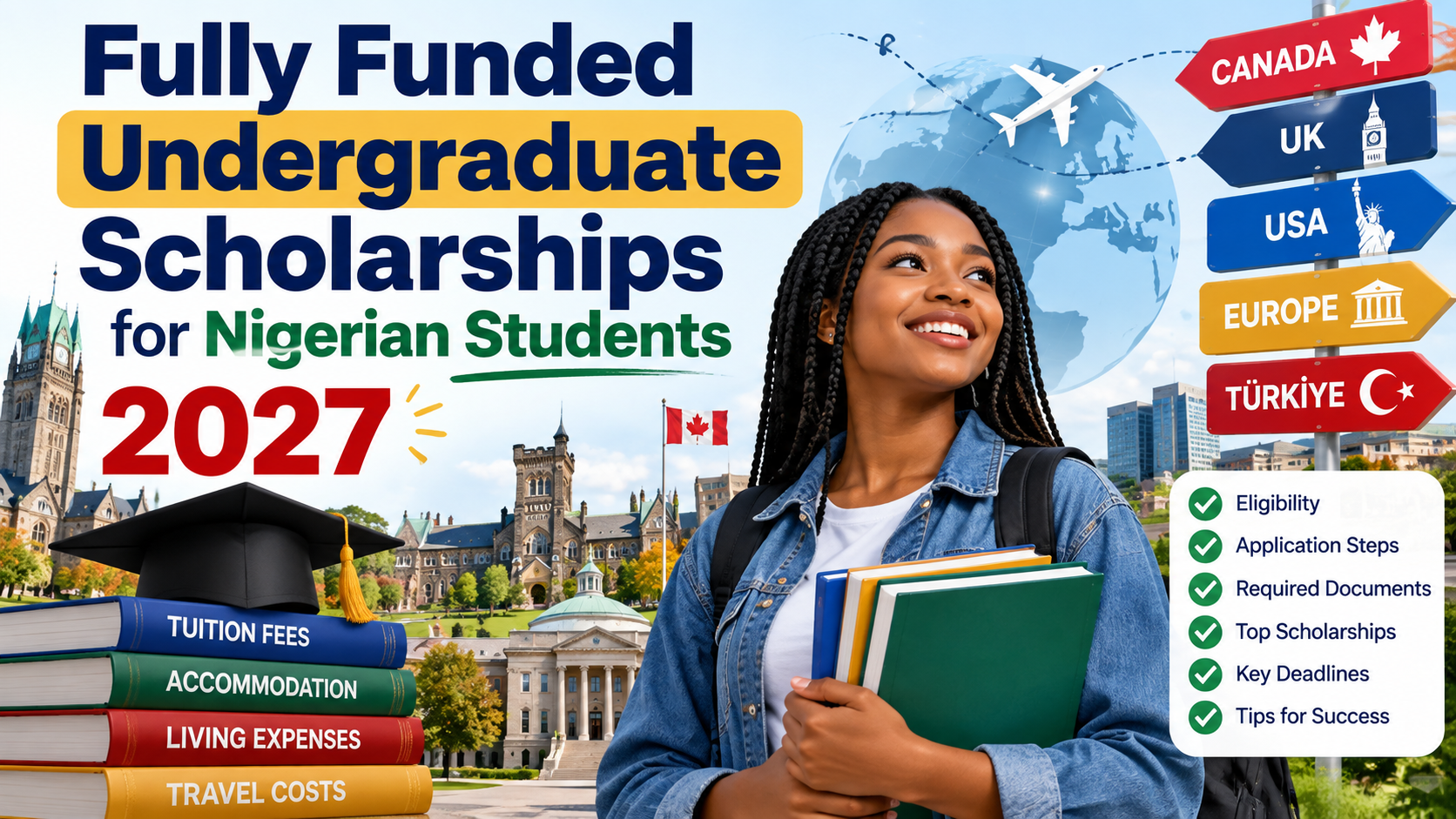
Quick answer: A fully funded scholarship normally covers the major costs required to complete a programme, especially tuition and living expenses. Depending on the award, it may also include travel, accommodation, health insurance, visa-related costs, research expenses or other allowances. “Fully funded” does not mean every personal expense is automatically covered.
Fully Funded Scholarships for Nigerians: At a Glance
| Question | Answer |
|---|---|
| Who is this guide for? | Nigerian students seeking major international scholarship routes |
| Does “fully funded” mean every expense is covered? | No. Benefits and exclusions differ by programme |
| What should be checked first? | Current application status, eligibility, funding terms and official deadline |
| Best source for final verification | The scholarship provider’s official website |
| Information last reviewed | 20 September 2026 |
AfricanBase Verified Answer: There is no universal benefits package for a fully funded scholarship. The safest test is whether the official award terms cover the principal costs of study and clearly state what remains the student’s responsibility. Applicants should verify each programme’s live terms before relying on the label “fully funded.”
Fully funded scholarships can make postgraduate or undergraduate study abroad possible for Nigerian students who could not otherwise meet tuition and living costs. But “fully funded” is often used too loosely online. A genuine full award should normally cover the major cost of study, although the exact package differs by programme.
This guide focuses on established scholarship programmes and shows you where to verify the current application cycle. For the difference between full and partial funding, read AfricanBase’s Fully Funded vs Partial Scholarships guide.
What Does “Fully Funded” Actually Mean?
There is no single universal benefits package. Depending on the scholarship, full funding can include tuition, a living stipend, travel, accommodation or housing support, insurance, visa-related costs, research support or other allowances.
Do not assume that every scholarship described as “full” covers every personal expense. Read the official award conditions and budget for costs that remain your responsibility.
Current Scholarship Status: September 2026
Commonwealth Master’s Scholarships 2027/28: applications opened on 8 September 2026 and the CSC deadline is 20 October 2026 at 16:00 BST. Nigeria is listed as an eligible country. Applicants must also follow the process and deadline of an approved nominating body; the CSC does not accept a direct application without the required nomination route.
See AfricanBase’s detailed Commonwealth Scholarships for Nigerian Students guide or the official Commonwealth Master’s Scholarships page.
Commonwealth Shared Scholarships 2027/28: candidate applications are scheduled to open in early November 2026 and close in mid-December 2026. The CSC says the eligible courses will be published in November.
Important: Commonwealth Distance Learning Master’s Scholarships are paused and will not run in 2026 or 2027. Do not rely on older articles advertising a current Distance Learning round.
Major Fully Funded Scholarship Routes for Nigerian Students
1. Commonwealth Master’s Scholarships — United Kingdom
Commonwealth Master’s Scholarships are funded by the UK Foreign, Commonwealth & Development Office for candidates from eligible low- and middle-income Commonwealth countries. Nigeria is eligible for the 2027/28 Master’s round.
- Level: taught Master’s.
- Current cycle: 2027/28 applications are open at this review date.
- CSC deadline: 20 October 2026, 16:00 BST.
- Application route: CSC Central plus the applicable nominating-body process.
- Key eligibility: includes academic requirements, permanent residence in an eligible country and inability to afford UK study without the scholarship.
2. Chevening Scholarships — United Kingdom
Chevening is the UK Government’s international scholarship programme for eligible one-year taught Master’s degrees. Nigerian applicants should use the official Chevening eligibility, work-experience, course and application guidance for the relevant cycle rather than relying on an old annual deadline.
AfricanBase maintains a dedicated Chevening Scholarship Nigeria guide. Verify the active cycle at Chevening’s official scholarship site.
3. Fulbright Foreign Student Program — United States
The Fulbright Foreign Student Program supports graduate students, young professionals and artists from outside the United States. The official Fulbright system lists Nigeria and directs Nigerian candidates through the U.S. Embassy/Public Affairs route.
Official programme information currently lists benefits including J-1 visa sponsorship, funding support, a health benefit plan and enrichment activities. Eligibility and selection procedures vary by country, so Nigerian candidates should follow the Nigeria-specific instructions rather than a generic U.S. scholarship checklist.
Official route: Fulbright Foreign Student Program — Nigeria.
4. Erasmus Mundus Joint Masters — Europe
Erasmus Mundus Joint Masters are international Master’s programmes delivered by groups of universities. Scholarships are available for selected students, but application dates and scholarship arrangements are programme-specific. Applicants normally apply directly to the individual Master’s programme.
Official route: Erasmus Mundus Joint Masters.
5. DAAD Scholarships — Germany
DAAD administers numerous scholarship programmes rather than one universal “DAAD fully funded scholarship.” Eligibility, professional-experience requirements, benefits and deadlines depend on the specific programme and course.
Nigerian applicants should search the official DAAD scholarship database and DAAD Nigeria information for a programme matching their degree level and field. Avoid copying stipend figures or a “two years’ work experience” rule from one DAAD programme and applying it to all DAAD awards.
Official starting point: DAAD Nigeria.
6. Chinese Government and University Scholarships — China
China has government and university scholarship routes for international students, but benefits, eligible programmes and application channels differ. AfricanBase has a dedicated Fully Funded Scholarships in China guide for Nigerian students that should be used alongside the current university or Chinese scholarship authority instructions.
7. Mastercard Foundation Scholars Program — Partner Universities
The Mastercard Foundation Scholars Program works through partner institutions. There is no single universal application form covering every partner. Degree levels, countries, eligibility and deadlines depend on the participating institution.
Apply through an eligible partner’s current admissions/scholarship process and verify that the institution is part of the Scholars Program for your intended intake.
Official programme: Mastercard Foundation Scholars Program.
8. MEXT Scholarships — Japan
Japan’s MEXT scholarships include several categories and application routes, including embassy recommendation and university recommendation. Degree level, age/academic criteria, examinations and deadlines depend on the scholarship category and annual call.
Nigerian applicants should use the Embassy of Japan in Nigeria and official Study in Japan/MEXT information for the current cycle rather than an old global deadline.
9. Knight-Hennessy Scholars — Stanford University
Knight-Hennessy Scholars supports graduate study at Stanford across eligible graduate programmes. Applicants must satisfy both the Knight-Hennessy process and the separate Stanford graduate programme requirements. Check the official site for the current cohort’s deadlines and funding conditions.
Official programme: Knight-Hennessy Scholars.
Scholarship vs University Financial Aid: Do Not Mix Them Up
The old version of this guide described university need-based financial aid, research funding and named scholarship programmes as though they were all the same thing. They are not.
For example, a university can meet demonstrated financial need for admitted international undergraduates without offering a separate scholarship called a “fully funded scholarship.” Graduate funding can also depend on the department, assistantship or research programme. Always identify the actual funding mechanism before applying.
Who Is Eligible for Fully Funded Scholarships?
There is no universal requirement that every Nigerian applicant must have a 2:1, two years of work experience, IELTS/TOEFL, leadership experience or a commitment to return to Nigeria. Those requirements belong to particular programmes.
Common selection factors can include academic performance, financial need, professional experience, leadership, development impact, research fit, nationality/residence, English-language evidence and admission to an eligible course. Check each programme individually.
Documents to Prepare
- Valid passport or other accepted identity document.
- Academic transcripts and certificates.
- CV/résumé where requested.
- Personal statement, motivation statement or scholarship essays.
- References/recommendation letters.
- Research proposal for programmes that require one.
- English-language evidence where required.
- Employment or professional-experience evidence where required.
- Admission application documents for scholarships tied to a university course.
For writing support, use AfricanBase’s Scholarship Essay guide and Scholarship Recommendation Letter guide.
How to Apply Without Missing Important Steps
- Choose by eligibility, not headline. Confirm nationality, degree level, field and academic requirements.
- Open the official programme page. Treat third-party scholarship articles as discovery tools, not the final application authority.
- Check whether university admission is separate. Some scholarships require two applications.
- Record every deadline. Scholarship, nominator and university deadlines can be different.
- Prepare evidence early. Transcripts and references can take time.
- Tailor essays. Address the programme’s actual selection criteria.
- Submit only through the official route. Be cautious of agents requesting payment for “guaranteed” scholarships.
- Keep copies. Save submitted forms and supporting documents.
How to Improve Your Scholarship Application
Strong applications are specific. Instead of making generic claims about leadership or financial hardship, show what you have done, what problem you want to address, why the proposed course is relevant and what you plan to do with the training.
Apply only where you genuinely meet the criteria. Multiple carefully targeted applications are generally more useful than mass-submitting the same statement to unrelated programmes.
If your academic record is below the requirement for some programmes, see AfricanBase’s Scholarships for Nigerian Students With a Low CGPA. If English-test requirements are a concern, see Scholarships With Alternative English-Language Requirements.
Frequently Asked Questions
Are there fully funded scholarships open to Nigerians right now?
Yes. At this review date, Commonwealth Master’s Scholarships for 2027/28 are open to eligible Nigerian candidates, with the CSC deadline on 20 October 2026. Other programmes operate on different calendars, so check their official current-cycle pages and use our month-by-month scholarship calendar to plan overlapping deadlines.
Are there more than 2,000 fully funded scholarships available to Nigerians?
AfricanBase has removed that old numerical claim because it did not have a sufficiently reliable source and mixed individual awards with programmes. Availability changes by year and institution.
Do I need a 2:1 for every fully funded scholarship?
No. Academic thresholds vary. Commonwealth Master’s Scholarships, for example, publish specific degree requirements, while other programmes use different criteria.
Can undergraduate Nigerian students get full funding?
Yes, some government, university and foundation routes support undergraduate students, but many major programmes such as Chevening and Commonwealth Master’s are postgraduate. Check the degree level before preparing an application.
Related AfricanBase Scholarship Guides
- Commonwealth Scholarships for Nigerian Students
- Chevening Scholarship Nigeria
- Fully Funded Scholarships in China
- Scholarships for International Students in Canada
- Fully Funded Scholarships in Canada for African Students
- Canada Public Health Scholarships for Nigerian Students
- Fully Funded vs Partial Scholarships
- How to Apply for Study-Abroad Scholarships from Africa
Final Note
A fully funded scholarship can remove major financial barriers, but the safest application strategy is to work from current official programme information. Use this page as your AfricanBase scholarship hub, then verify the live deadline, eligibility, funding package and application route before submitting anything.


How do I apply